
US Tariffs Create New Opening for Indonesia’s Solar Industry
Kabarsaji.com – Steep new US import duties on solar panels may redirect more Indonesian-made modules toward the home market, giving the country’s renewable-energy industry a potential boost as it prepares for much larger solar deployment.
The additional US tariff, which can reach 114 percent for solar panel products, has complicated access to a market that had been an export destination for Indonesian producers. Indonesian officials now see an opportunity to turn that disruption into stronger domestic demand, particularly as the country pursues ambitious solar power expansion.
Elen Setiadi, Deputy for Coordination of Energy and Mineral Resources at the Coordinating Ministry for Economic Affairs, said the tariff environment could help strengthen the national market for locally produced panels.
“Our industry for solar panels was previously exporting to America. However, some time ago, due to the imposition of an additional tariff of up to 114 percent, this opportunity can actually be absorbed in the domestic market,” Elen stated.
Production Capacity Already in Place
Indonesia’s solar module industry has built annual manufacturing capacity of roughly 11 gigawatts. That level of output could support a faster rollout of solar power plants, including a proposed program aimed at developing 100 gigawatts of solar generation.
The scale of that proposed program illustrates why domestic manufacturing has become a central policy concern. A 100 GW solar buildout could create as many as 5.5 million green jobs, cut carbon dioxide emissions by around 140 million tons, and generate annual savings of up to Rp74 trillion.
For Indonesia, the issue is not simply whether enough solar panels can be made. It is also whether new projects can create a reliable market for those panels and retain more of the economic value within the country. Expanding solar generation while using domestic modules could link electricity development with industrial growth, employment, and investment in local production capability.
Government data shows that 34 domestic solar module manufacturers are currently operating, with combined annual capacity of 10,994 megawatts peak. Their products can reach a maximum capacity of about 720 watts peak per module. The average domestic component level, known as TKDN, is estimated at approximately 40 to 55 percent.
Domestic Demand Remains the Key Challenge
Despite the available manufacturing base, several obstacles continue to limit the industry’s prospects. Solar power plant projects have not yet been realized at the pace needed to absorb the full volume of locally made modules. This gap leaves manufacturers dependent on export opportunities that can quickly shift when trade policies change abroad.
Existing TKDN rules for solar power plants also present a challenge. Minimum local-content requirements still permit imported solar modules to be used, reducing the certainty that planned projects will become customers for Indonesian producers.
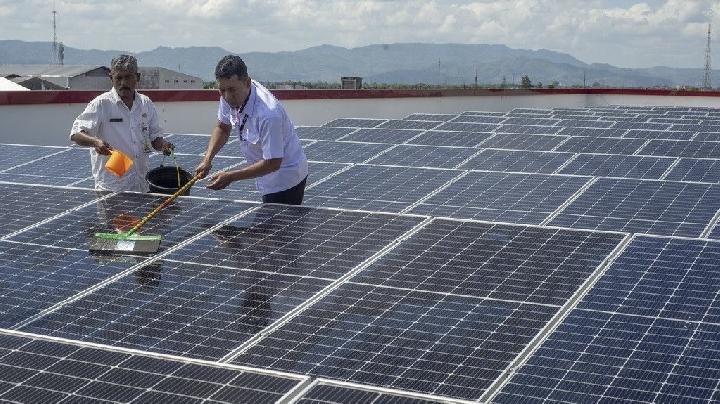
Rooftop solar is another important part of the domestic-demand equation. Quotas for rooftop installations remain limited and have not met all industrial-sector requests for solar panel use. Larger rooftop allocations could allow factories and other businesses to install more solar capacity while creating a clearer market for domestically produced equipment.
Elen said incentives outside the tax system could help encourage greater use of local modules. One option under consideration is to provide more generous rooftop solar quotas to users who choose Indonesian-made products.
“If the 100 GW target can be achieved, our industry can actually be developed. Currently, the potential is already 11 GW,” she added.
Building a More Resilient Supply Chain
A stronger local market alone would not resolve every issue facing the solar sector. Indonesia still relies on global supply chains for key inputs, including wafers and ingots. Developing those links closer to home would reduce exposure to international supply disruptions and help improve the domestic value contained in finished panels.
The government is therefore encouraging supply-chain development alongside the expansion of solar installations. Greater availability of raw materials and intermediate components would allow Indonesia’s module industry to rely less heavily on imported inputs while making the sector more durable over the long term.
Partnerships between Indonesian and international companies are also being encouraged. Such arrangements could bring new investment, technology transfer, and manufacturing expertise, while helping local producers deepen their supply networks.
The US tariff episode highlights a broader reality for solar manufacturers: export markets can be valuable, but they can also be vulnerable to abrupt policy changes. For Indonesia, the response may be to create a domestic market large enough to support its existing factories and future investment.
Whether that opportunity is realized will depend on the pace of solar project construction, rooftop quota policy, local-content implementation, and progress in building a more complete supply chain. With nearly 11 GW of annual module capacity already available, Indonesia has a significant industrial foundation. Turning that capacity into sustained domestic growth will require solar deployment to move from policy ambition into projects on the ground.
Related Reading
Frequently Asked Questions
What is How Trump s Tariffs Could Boost?
How Trump s Tariffs Could Boost is the main topic of this guide. The article explains the context, practical details, and next steps readers should understand.
Why does How Trump s Tariffs Could Boost matter?
How Trump s Tariffs Could Boost matters because readers are looking for a useful answer, not just a short summary. Good content should match search intent and help them decide what to do next.