
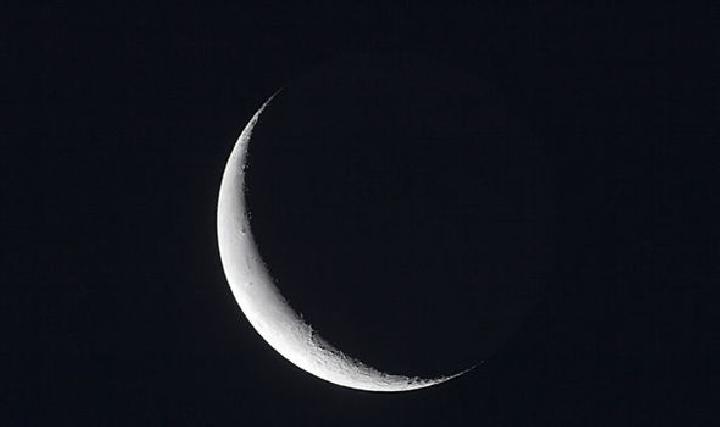
A Fading Sliver and a Giant Planet: What the Early-Morning Sky Holds This Week
Kabarsaji.com – On the morning of September 8, 2026, skywatchers across the United States will catch a brief but striking pairing: a razor-thin crescent Moon hanging low near Jupiter in the eastern dawn. The encounter marks one of the final days before the Moon vanishes entirely from view, and it offers a compact window into the mechanics of the lunar cycle that repeats every 29.5 days.
The waning crescent — the last recognizable shape the Moon takes before disappearing — will be observable in pre-sunrise skies from September 7 through September 10, weather permitting. After clearing the Third Quarter on September 4, the Moon has been steadily shedding its lit face, and by late Thursday evening (11:27 p.m. EDT on September 10, shifting to September 11 in much of Asia and the Pacific), the New Moon arrives and the disk goes dark from Earth’s vantage point.
What the Waning Crescent Actually Is
The term combines two descriptors. “Waning” signals that the illuminated fraction is shrinking; “crescent” names the thin, curved silhouette that results. Astronomically, this phase spans the interval between the Third Quarter — when roughly half the near side faces the Sun — and the New Moon, when the near side is essentially unlit. Over those final days the visible lit area contracts from about 50 percent down to zero.
Unlike the Full Moon, which dominates the night sky for hours, the waning crescent is fundamentally a morning object. It clears the eastern horizon well after midnight and lingers above the skyline into the late morning or early afternoon before sinking below the horizon. That timing is what makes the September 7–10 window a dawn affair rather than a nighttime one.
Why the Moon Appears to Shrink
The Moon’s physical illumination never changes: sunlight always lights exactly half the sphere. What changes is geometry. As the Moon drifts in its orbit toward the Sun’s direction, Earth-based observers see progressively less of that sunlit hemisphere. By the final days of the crescent, only a narrow arc of light remains visible. At New Moon the near side is turned away from the Sun, and the disk becomes effectively invisible against the daylight sky.
The sharp boundary between the lit and dark regions is called the terminator. Watching the terminator migrate across the lunar surface over successive nights provides a tangible, real-time demonstration of orbital mechanics — no telescope required, just a clear eastern horizon and a few minutes of patience before sunrise.
Earthshine and the “Da Vinci Glow”
When the crescent is extremely thin, observers with dark-adapted eyes may notice a faint, ghostly glow filling the rest of the lunar disk. This is earthshine: sunlight that struck Earth’s oceans and continents, reflected back into space, and now illuminates the Moon’s dark side just enough to make its outline perceptible. The phenomenon has been called the Da Vinci glow, after Leonardo’s famous sketch of a crescent with its companion shadow.
Earthshine is most conspicuous when the crescent is at its slimmest and the surrounding sky is still deep blue or black — conditions that align precisely with the pre-dawn hours of September 9 and 10 this week.
Orientation: Why Your Crescent Looks Different From Someone Else’s
The fraction of the Moon illuminated by the Sun is identical for every observer on Earth at any given instant. What varies is the apparent tilt of the crescent’s horns. Latitude, local time, and the Moon’s altitude above the horizon all rotate the terminator’s orientation. A crescent photographed in Jakarta will show a different horn angle than one captured in Sydney or Minneapolis, even though both images were taken at the same moment.
This geometric effect is purely perspectival; no physical difference exists between the two views. It is a useful reminder that the Moon’s “shape” as we perceive it is a product of our position in space and time, not an intrinsic property of the object.
Viewing Guidance for the September 7–10 Window
Face east roughly 45 to 90 minutes before local sunrise. The crescent will sit low, increasingly close to the Sun’s position in the sky, and will grow fainter each successive morning. Because rising and setting times shift by several minutes between cities, the exact usable window differs from place to place within the United States.
The September 8 Jupiter conjunction adds a bright, steady companion to the scene. Jupiter will appear as a fixed, non-twinkling point of light near the crescent’s horns, offering a natural scale reference and a memorable photographic subject for anyone with a smartphone or compact camera.
What Follows the New Moon
The lunar cycle does not stop at darkness. Within a day or two of the September 10 New Moon, a sliver of waxing crescent will reappear in the western evening sky, growing through First Quarter, waxing gibbous, and Full Moon before the cycle turns back through waning gibbous, Third Quarter, and another waning crescent. Tracking the Moon across even five or six consecutive nights — from a broad half-lit disk to a vanishing sliver and back — provides an accessible, repeatable lesson in orbital geometry that requires nothing more than clear skies and a willingness to look up at slightly inconvenient hours.
The Moon’s changing face is not a trick of light or shadow alone; it is a direct, naked-eye readout of its position in a 29.5-day orbit around Earth, written in sunlight across a sphere 384,400 kilometers away.
For those who wish to extend the observation beyond this week’s crescent, the next notable lunar event in the same month is Venus passing behind the Moon on September 14, an occultation that will briefly remove the brightest planet from view and restore it minutes later on the opposite side of the disk.
Related Reading
Frequently Asked Questions
What is Waning Crescent Moon?
Waning Crescent Moon is the main topic of this guide. The article explains the context, practical details, and next steps readers should understand.
Why does Waning Crescent Moon matter?
Waning Crescent Moon matters because readers are looking for a useful answer, not just a short summary. Good content should match search intent and help them decide what to do next.