Federal Judge Temporarily Blocks Government-Funded Trump Television Campaign
Kabarsaji.com – A federal judge in New York has ordered the Trump administration to stop any remaining television advertisements that used taxpayer money to promote President Donald Trump and his political message. The temporary restraining order, issued Sunday night by District Judge Jennifer L. Rochon, pauses the campaign for two weeks while the underlying legal challenge proceeds.
The commercials began appearing on television in late September and quickly drew criticism from across the political spectrum. They featured Trump speaking about his policy agenda, warning viewers about communism, and portraying the moment as a “final battle” against “globalists.” Each advertisement concluded with a notice stating that it had been financed by the US government.
Judge Rochon ruled in favor of a group of plaintiffs that includes Common Cause, the nonpartisan government-watchdog organization. Her order prevents officials from continuing, restarting, broadening, or renewing agreements connected to the production or distribution of the disputed advertisements during the two-week period.
“Defendants shall not enter into, renew, or expand any agreement authorizing the development, creation, dissemination, placement, or airing of the challenged advertisements” during the two-week duration of her order.
Campaign Had Used $20 Million in Public Funds
The Department of Homeland Security allocated $20 million, or roughly €17.8 million, in taxpayer funds for the advertising effort. The dispute centers on whether federal agencies may spend congressionally approved money on messages that appear to promote a sitting president’s political interests.
Legal specialists involved in the controversy have argued that the campaign may violate a federal restriction on the use of appropriated funds for “publicity or propaganda.” The lawsuit also raises broader questions about the limits on executive agencies when communicating with the public, particularly when the content is closely tied to a president’s personal political profile.
A temporary restraining order is not a final ruling on the merits of the case. Instead, it is a short-term court intervention intended to preserve the situation while judges consider whether a longer-lasting block is warranted. In this instance, the order means the administration cannot move forward with the challenged ads while the court examines the plaintiffs’ arguments.
The Justice Department had urged the court not to issue the order. In a filing submitted late Saturday, it argued that court action was unnecessary because the conduct at issue was already set to stop the following day.
“The alleged offending conduct will end tomorrow.”
Judge Rochon nevertheless issued the temporary halt. The decision ensured that the campaign could not simply be extended, renewed, or otherwise continued during the immediate period covered by her ruling.
White House Says Political Committee Will Cover Future Ads
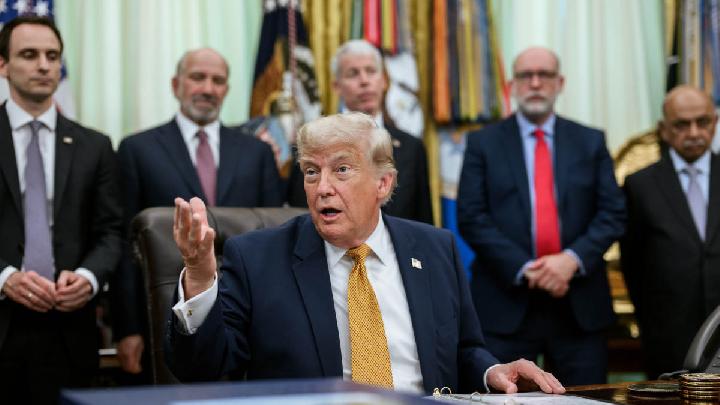
Trump addressed the advertising controversy on Monday, describing the commercials as “rather standard” and calling them a “positive promotion for our great USA.” He said, however, that taxpayer money would no longer be used to finance them.
The White House had previously said that Trump’s political action committee would pay for advertisements going forward. That arrangement would shift future costs away from federal funds, but it would not repay taxpayers for commercials that had already aired using public money.
The distinction has become central to the legal and political debate. Ending public financing may prevent additional taxpayer spending, but the plaintiffs contend that it does not resolve whether the initial use of government money was lawful. Their case seeks accountability for the prior campaign as well as safeguards against similar actions by future administrations.
The plaintiffs include a public employee union and a candidate for the Alabama state House of Representatives. They asked the judge to act before the weekend so the advertisements would not run during high-profile programming, including football broadcasts and Saturday Night Live.
Challenge Focuses on Government Power and Electoral Influence
Democracy Forward, the nonprofit organization representing the plaintiffs, said the case concerns the use of federal resources in ways that could affect elections and benefit a president’s own political agenda.
“There is no legal justification — and no precedent — for the president to use the machinery of the government and funds set aside by Congress for other uses to influence electoral outcomes that further his own agenda,” the plaintiffs said.
Common Cause President and CEO Virginia Kase Solomon said the group would continue seeking a full accounting of the administration’s actions.
“We won’t stop until this administration is held fully accountable, and no president from any party can waste and abuse taxpayer funds for propaganda ever again,” Solomon said.
The controversy is not limited to the New York case. Democrats have filed a separate federal lawsuit in Washington challenging the same advertisements. Together, the cases place renewed attention on the boundary between official government communications and political promotion.
For readers, the issue extends beyond a single ad campaign. Federal agencies routinely communicate information about public programs, policy changes, emergencies, and government services. The legal dispute asks when that communication crosses into political advocacy and whether taxpayer-funded messaging can be used to elevate an elected official rather than serve a clearly defined public purpose.
The New York order remains temporary, and further court decisions will determine whether the advertising campaign faces a longer prohibition or whether the administration can successfully defend its use of funds. For now, the ruling bars new or expanded arrangements for the disputed commercials and gives the court time to consider the broader constitutional, statutory, and public-accountability questions raised by the case.
Related Reading
Frequently Asked Questions
What is US Judge Orders Halt to Taxpayer?
US Judge Orders Halt to Taxpayer is the main topic of this guide. The article explains the context, practical details, and next steps readers should understand.
Why does US Judge Orders Halt to Taxpayer matter?
US Judge Orders Halt to Taxpayer matters because readers are looking for a useful answer, not just a short summary. Good content should match search intent and help them decide what to do next.