
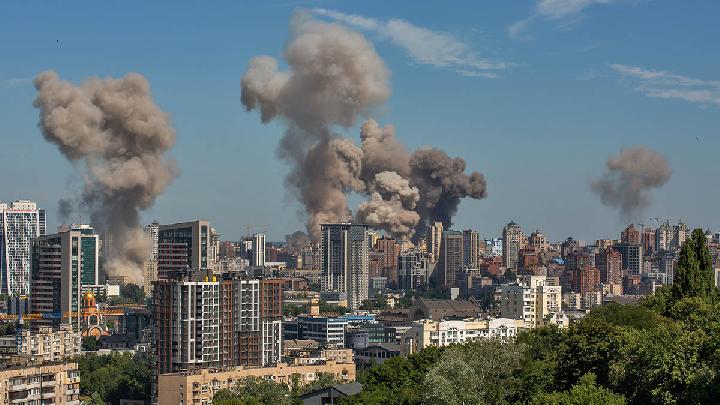
Russian Drone Attack on Kyiv Petrol Station Leaves Two Dead
Kabarsaji.com – Two people were killed after Russian jet-powered drones hit a petrol station in Kyiv on Friday, marking a deadly escalation in attacks on civilian energy and commercial infrastructure in Ukraine’s capital.
The strike also injured 12 people, including a 12-year-old boy, Kyiv Mayor Vitali Klitschko said. One of those hurt was an emergency worker responding to the initial impact, Ukrainian President Volodymyr Zelenskyy said, describing the incident as a “double-tap strike.”
Such attacks create particular danger for rescuers, firefighters and medical personnel, who can arrive at a damaged site only to face another explosion or drone strike. Petrol stations are especially hazardous targets because of the presence of fuel, vehicles and nearby customers or workers.
Petrol stations increasingly exposed
The Kyiv attack came one day after what was believed to be the first Russian strike on a gas station in the capital during the war. Russia has hit roughly 300 petrol stations across Ukraine in recent months, with many of those locations situated in frontline regions or areas close to the fighting.
Ukraine has said Russia is increasingly using newer jet-powered drones that are faster and more difficult to intercept than earlier systems. The drones have been used against logistics sites, warehouses, commercial supply routes and energy-related facilities.
While petrol stations do not appear to be military targets in themselves, their destruction can affect everyday civilian movement, fuel deliveries and local businesses. Damage to fuel infrastructure can also complicate emergency response and disrupt supplies in communities already coping with air-raid threats and power-related pressures.
The station struck in Kyiv belongs to Ukrnafta, Ukraine’s major oil company. Another Ukrnafta station was also hit on Friday morning. The company’s chief executive, Bogdan Kukura, condemned what he called a deliberate attack on civilian property.
“There is no military objective in such attacks. This is terror against the civilian population,” Bogdan Kukura said.
Zelenskyy calls for stronger air defense
Zelenskyy said the attacks showed an intensifying Russian campaign against civilian energy infrastructure. He urged greater attention to Ukraine’s air defenses and to measures designed to counter Russian drones.
“Maximum attention must be focused on protecting the skies, finding solutions to protect people, and scaling up countermeasures against Russian drones,” Zelenskyy said in a post on X.
Russia has not publicly commented on the latest strikes. Moscow has repeatedly denied deliberately targeting civilians, despite extensive damage from the conflict to Ukrainian cities, homes, transport networks, power systems and other civilian facilities.
The attack underscores how the war’s aerial dimension has expanded beyond the battlefield. With much of the fighting along eastern Ukraine’s front lines remaining largely stalled, both sides have increasingly sought to weaken the other’s ability to sustain the war through strikes on transport, fuel, energy and logistics networks.
Drone warfare spreads across the border
Ukraine has also intensified long-range drone operations inside Russia, saying the attacks are intended to reduce Moscow’s capacity to fund, supply and support its military campaign. Ukrainian strikes have targeted oil refineries, energy facilities and logistics infrastructure.
Russian officials said two people were killed overnight in the Tula region, while another person died in the Kursk region on Friday. Tula Governor Dmitry Milyayev said three additional people were injured.
In Saratov, a Ukrainian drone struck a logistics hub operated by Ozon, Russia’s second-largest e-commerce platform, starting a fire. More than 20 warehouses connected to Ozon and Wildberries, another major Russian online retailer, have been hit in Ukrainian attacks in recent weeks.
The targeting of warehouses and distribution centers reflects the broader pressure both countries are placing on economic infrastructure. These sites can serve civilian commerce, but they may also affect transport capacity, supply availability and regional employment when damaged or forced to halt operations.
For residents of Kyiv, Friday’s strike is another reminder that the threat from drones is no longer limited to military installations or areas near the front. Attacks on fuel stations, warehouses and other commercial locations can turn ordinary parts of city life into high-risk sites, while emergency workers remain exposed as they respond to the aftermath.
More than four and a half years after Russia began its full-scale invasion, the conflict continues to exact a human toll far from the main combat zones. The deaths in Kyiv, including the injuries to civilians and a responder, highlight the continuing vulnerability of populated areas as both sides expand attacks on infrastructure tied to the broader war effort.
Related Reading
Frequently Asked Questions
What is Ukraine?
Ukraine is the main topic of this guide. The article explains the context, practical details, and next steps readers should understand.
Why does Ukraine matter?
Ukraine matters because readers are looking for a useful answer, not just a short summary. Good content should match search intent and help them decide what to do next.