Indonesia’s Disaster Toll Prompts Prabowo to Float Consolidation of Two Key Science Agencies
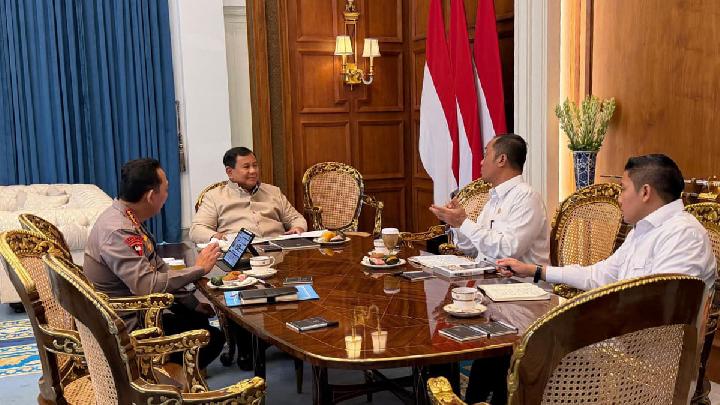
Kabarsaji.com – A relentless cascade of earthquakes, volcanic eruptions, and wildfires sweeping across the Indonesian archipelago has pushed President Prabowo Subianto to propose a structural overhaul of the country’s disaster-science infrastructure. In a closed-door session held at the Merdeka Palace in Jakarta on Monday, September 7, 2026, the president suggested that the Meteorology, Climatology, and Geophysics Agency (BMKG) and the Geological Agency — currently housed under the Ministry of Energy and Mineral Resources (ESDM) — could eventually be folded into a single unified body.
The remark came during a limited meeting focused on the latest developments in national disaster management. Prabowo did not outline a timeline, a legal mechanism, or a staffing plan for the proposed consolidation. He framed it as a future consideration rather than an immediate directive, telling attendees that the question would be revisited after further deliberation.
“Later on, we will consider whether the Geological Agency should be integrated with BMKG. But we will discuss this later,” Prabowo said.
Why the Merger Idea Surfaces Now
The timing of the proposal is inseparable from the extraordinary density of natural hazards Indonesia has endured in recent weeks. Flores, in East Nusa Tenggara, has been struck by repeated seismic events. Mount Anak Krakatau, the young volcanic island in the Sunda Strait, has shown heightened eruptive activity. Across multiple provinces, land and forest fires have generated hazardous haze conditions that degrade air quality and threaten public health. The convergence of these crises within a compressed timeframe has sharpened the question of whether Indonesia’s fragmented institutional architecture for monitoring geological and meteorological hazards is fit for purpose.
BMKG, established as a standalone agency in 2010, handles weather forecasting, climate monitoring, and seismic observation. The Geological Agency, operating beneath ESDM, focuses on subsurface geology, mineral resources, and geological hazard mapping. In practice, both bodies collect overlapping data during events such as volcanic eruptions or major earthquakes, yet they report through separate administrative channels. Critics of the current split have long argued that the duplication slows the flow of integrated hazard assessments to local governments and to the public during fast-moving emergencies.
The President’s Account of the Crisis
Prabowo used the limited session to catalogue the concurrent disasters now burdening the nation. He described Indonesia as grappling with multiple simultaneous crises rather than a single event, a distinction that carries significant operational weight for emergency responders who must allocate scarce resources across competing fronts.
“I just want to monitor developments and hear about the current situation,” Prabowo said.
He named the Flores earthquakes, the Anak Krakatau activity, widespread land and forest fires, and the resulting haze as the principal ongoing emergencies. The president then placed the situation in its broader geological context, invoking the tectonic reality that defines Indonesia’s hazard profile.
“This is our fate as a country located on the Ring of Fire,” Prabowo said.
That framing is not rhetorical flourish. Indonesia sits astride the Pacific Ring of Fire, where the convergence of the Indo-Australian, Eurasian, and Pacific plates produces roughly 130 active volcanoes and makes the archipelago one of the most seismically active regions on Earth. The country’s roughly 17,000 islands span multiple tectonic boundaries, meaning that no single monitoring framework can capture the full spectrum of hazards without coordination across disciplines.
Budget Signals and Institutional Direction
Beyond the merger question, Prabowo directed the Geological Agency’s head, Lana Saria, to deepen collaboration with other line ministries and state agencies involved in disaster response. The instruction signals an intent to break down the silos that currently separate geological data, meteorological forecasting, and emergency-management operations.
The president also disclosed plans to substantially raise the national budget line dedicated to disaster mitigation. He characterized the recent disaster wave as a corrective lesson for his administration.
“This is a lesson for us and the government I lead. The budget allocation for disaster mitigation must be significantly increased,” Prabowo concluded.
A budget increase of this kind would flow through multiple channels: early-warning sensor networks, evacuation infrastructure, post-disaster reconstruction funds, and the operational costs of the agencies themselves. For BMKG and the Geological Agency alike, additional funding could mean denser seismic station coverage in outer islands, improved volcanic gas monitoring, and faster satellite-based fire detection — capabilities that have historically lagged behind the pace of hazard events in remote regions.
What a Consolidated Agency Would Mean in Practice
If the merger proceeds, the resulting institution would inherit both BMKG’s atmospheric and seismic-observation mandate and the Geological Agency’s subsurface-mapping and mineral-resource functions. The administrative challenge would be considerable: two distinct organizational cultures, different reporting lines, and overlapping but non-identical technical competencies would need to be reconciled under a single directorate. International precedents — such as the United States Geological Survey’s integration of earthquake and volcanic monitoring under one roof, or Japan’s Meteorological Agency’s close operational coupling with its geological survey — suggest that consolidation can sharpen response times, but only if accompanied by clear internal governance rules and sustained funding.
For now, the proposal remains at the stage of a presidential remark in a closed session. No legislation has been drafted, no cabinet decision announced, and no transition timetable published. What is clear, however, is that the scale of Indonesia’s recent disaster experience has moved the question of institutional consolidation from the margins of academic debate into the center of executive deliberation.
Related Reading
Frequently Asked Questions
What is Prabowo Eyes Merger of Geological Agency?
Prabowo Eyes Merger of Geological Agency is the main topic of this guide. The article explains the context, practical details, and next steps readers should understand.
Why does Prabowo Eyes Merger of Geological Agency matter?
Prabowo Eyes Merger of Geological Agency matters because readers are looking for a useful answer, not just a short summary. Good content should match search intent and help them decide what to do next.