
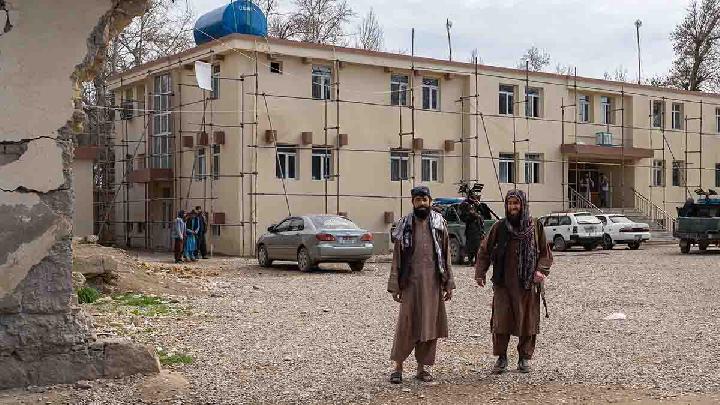
Pakistan-Afghanistan Tensions Escalate as Security, Borders and Militancy Collide
Kabarsaji.com – Pakistan’s overnight strikes on targets inside Afghanistan have pushed a fragile regional relationship into another dangerous phase, with Islamabad and the Taliban authorities offering sharply different accounts of the casualties.
The Taliban government said nine or 10 civilians, including women and children, died in the Thursday night attack. Pakistan said its operation killed 22 militants and hit weapons and ammunition storage sites. The conflicting claims underline how quickly security incidents between the neighboring countries are becoming harder to verify and more difficult to contain.
The latest violence follows a renewed confrontation that began in mid-September after a period of relative calm. A series of assaults on Pakistani security personnel raised tensions, particularly after a September 18 attack on a police compound in Kohat, a northwestern city in Khyber Pakhtunkhwa province near the Afghan frontier. Thirty-one people were killed and more than 100 injured.
A faction linked to Tehreek-e-Taliban Pakistan, commonly known as the TTP or Pakistani Taliban, claimed responsibility for the Kohat attack. Pakistan then accused Afghanistan of allowing the group to operate from a safe haven across the border. Kabul rejected that accusation, but border clashes and Pakistani airstrikes soon followed.
Two Taliban movements, separate objectives
The TTP should not be treated as the same organization as Afghanistan’s Taliban. The groups share ideological affinities and personal connections, yet the TTP is an independent movement whose campaign is directed against the Pakistani state.
During Afghanistan’s lengthy war against international and United States forces, many TTP fighters supported the Afghan Taliban. When the Taliban returned to power in Kabul in 2021, the Pakistani Taliban gained greater space and influence. That development has complicated Pakistan’s long-standing approach to Afghanistan: a neighbor once viewed as a potential partner has increasingly become a source of security concern.
Islamabad has urged the Taliban authorities to curb the TTP. The demand is politically difficult because of the relationships built over years of conflict, shared networks and overlapping social ties.
“Because of these personal connections and networks, it is extremely difficult for the Afghan Taliban to break away,” says Conrad Schetter, director of the Bonn International Center for Conflict Studies.
Those ties do not necessarily mean that Kabul can command the TTP. Historical links exist, but they do not automatically translate into direct operational control or a strong chain of authority between the two movements.
“The Taliban are simply not prepared to take orders from Islamabad,” says Thomas Ruttig, co-director of the Afghanistan Analysts Network. “They won’t let anyone outside interfere.”
For Pakistan, this exposes the limits of a policy that expected support for the Afghan Taliban to produce lasting influence in Kabul. The reality is more complicated: the Taliban government has its own priorities, while the TTP maintains its own agenda and armed presence.
A border shaped by history and identity
Today’s conflict is also rooted in a far older dispute over the Durand Line. The boundary was drawn in 1893 by a British diplomat and an Afghan emir to define spheres of influence between British India and Afghanistan. Pakistan’s present border with Afghanistan follows that line.
Its significance goes beyond a map. The border cuts through Pashtun communities on both sides. Pashtuns are Afghanistan’s largest ethnic group and Pakistan’s second-largest. For many people in the region, the disagreement therefore involves identity, family and historical belonging as well as territorial control.
“Ethnic and nationalist elements play a significant role in the conflict,” Schetter says.
Many Pashtuns continue to reject the border created by the Durand Line. That unresolved sentiment can make efforts to impose stricter crossings, fencing and security controls especially sensitive. Any border confrontation can carry local consequences that extend well beyond the immediate military incident.
Pakistan’s rivalry with India adds another layer. Islamabad traditionally saw a friendly government in Kabul as helpful in its strategic competition with New Delhi. India, however, has also strengthened relations with the Taliban authorities.
“While Islamabad once viewed Afghanistan as a source of ‘strategic depth’ in its rivalry with India, it now increasingly views its north-western neighbor as a liability,” an analysis by Chatham House notes.
Trade routes become a lever of pressure
Pakistan still retains important influence because Afghanistan is landlocked and depends on transport connections through neighboring states. Pakistani routes are particularly significant for Afghan trade, giving Islamabad the ability to exert pressure through border closures and commercial restrictions.
The Taliban authorities have sought to reduce that dependence by pursuing other economic and political partners. Yet trade, transit and border access remain inseparable from the wider security dispute. A closure intended as political pressure can affect businesses, travelers and communities that rely on cross-border movement, while security concerns can quickly turn commercial negotiations into diplomatic confrontations.
There have been attempts to prevent the relationship from deteriorating further. Pakistan previously held TTP talks mediated by the Taliban, and ceasefires were reached. Pakistani and Afghan representatives also held discussions. But temporary arrangements did not settle the central issue: how to stop attacks in Pakistan while addressing Islamabad’s claim that TTP members can find refuge in Afghanistan.
That unanswered question remains at the heart of the current escalation. Pakistan faces a continuing militant threat, while the Taliban government resists outside demands that it sees as interference in Afghan affairs. With civilian casualty claims disputed, historical border tensions unresolved and trade now entangled with security, even a limited strike or frontier clash risks triggering a broader crisis.
Related Reading
Frequently Asked Questions
What is Pakistan vs Afghanistan?
Pakistan vs Afghanistan is the main topic of this guide. The article explains the context, practical details, and next steps readers should understand.
Why does Pakistan vs Afghanistan matter?
Pakistan vs Afghanistan matters because readers are looking for a useful answer, not just a short summary. Good content should match search intent and help them decide what to do next.