
Volcanic Ash from Anak Krakatau Grounds Jakarta’s Main Airport for Four Hours
Kabarsaji.com – Passengers at Indonesia’s busiest international gateway faced an early-morning disruption when volcanic ash drifting from Mount Anak Krakatau prompted a full operational shutdown of Soekarno-Hatta International Airport. The Directorate General of Civil Aviation (DGCA), operating under the Ministry of Transportation, issued NOTAM A3341/26 to close the airport from 01:30 to 05:30 WIB (Western Indonesian Time) on Sunday, September 6, 2026. The four-hour window was triggered after instrumented checks confirmed ash particles had reached the airfield surface.
How the Closure Was Triggered
Between 00:35 and 01:05 WIB on the morning of September 6, ground crews at Soekarno-Hatta conducted what aviation authorities term a “paper test” — a procedure in which standardized test strips are exposed to ambient air to detect particulate contamination. The results confirmed the presence of volcanic ash at the airport, prompting an immediate decision to suspend all takeoffs and landings until conditions could be verified as clear.
“This action was taken following ‘paper test’ results conducted on Sunday (September 6) between 00:35 WIB and 01:05 WIB, which indicated the presence of volcanic ash at Soekarno-Hatta International Airport,” said Director General of Civil Aviation Lukman F. Laisa in a statement issued in Jakarta on Sunday.
The precaution was not taken in isolation. Monitoring data compiled as of 22:00 WIB on September 5, 2026, already showed that 33 scheduled flights at the airport were at risk of disruption. By the time the closure took effect, the full scope of operational knock-on effects had become apparent.
Scope of Flight Disruptions
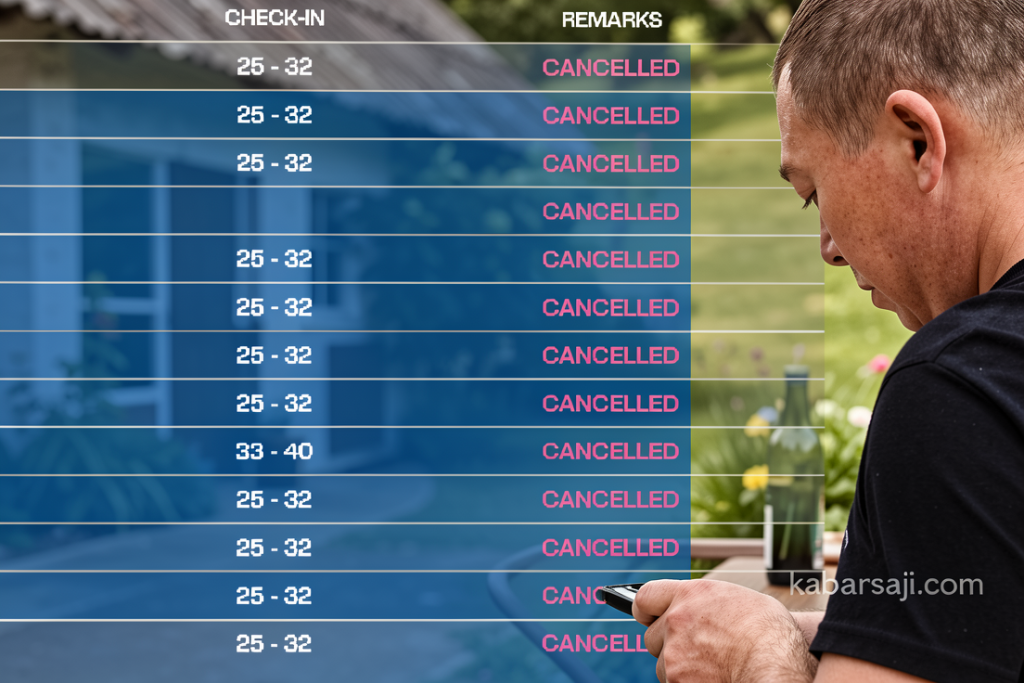
The international segment absorbed the heaviest share of the impact. Of the affected long-haul and regional services, 16 were cancelled outright, seven were pushed back by delay, and five were rescheduled to later time slots. Disrupted routes spanned a wide geographic arc: Singapore (SIN), Hong Kong (HKG), Sydney (SYD), Seoul/Incheon (ICN), Doha (DOH), Amsterdam (AMS), and Kuala Lumpur (KUL). For many of these carriers, a single missed slot at CGK can cascade through an entire overnight rotation, leaving crews and aircraft stranded beyond their maximum duty limits.
Domestic operations were less severely hit but still felt the effect. Four internal flights were cancelled and one was diverted to an alternate airport. The affected domestic routes included services to and from Lampung (TKG), as well as flights connecting to Denpasar (DPS) and Surabaya (SUB) — two of Indonesia’s most heavily trafficked secondary hubs.
Managing the Cascading Aftermath
The DGCA signalled that its focus would shift immediately to restoring normal schedules on September 6, 2026. The agency flagged several compounding variables that make recovery more complex than simply reopening the gates: aircraft rotation timing, fleet availability at other bases, downstream flight schedules already locked into crew rosters, and terminal capacity constraints during peak recovery windows. A single four-hour closure, if it strands widebody aircraft overnight, can ripple through an airline’s network for 24 to 48 hours.
“Safety remains the top priority in every operational decision, including flight schedule adjustments made by airlines. Operational adjustments will continue to be made dynamically based on evolving conditions on the ground,” said Lukman.
The agency confirmed it would maintain intensive, round-the-clock coordination with airline operators, airport management, air navigation service providers, and the Badan Meteorologi, Klimatologi, dan Geofisika (BMKG) — Indonesia’s meteorological and geophysical agency — to track the trajectory of any further ash dispersal from Anak Krakatau and its bearing on flight operations at CGK.
What Travellers Should Know
The DGCA urged the travelling public to check directly with their airline for real-time status updates rather than relying solely on airport signage or third-party tracking apps, which may lag behind operational changes. Passengers with connections through Jakarta were advised to build in additional buffer time and to confirm whether their ticket is rebookable without penalty under the carrier’s disruption policy.
For context, Mount Anak Krakatau sits in the Sunda Strait roughly 32 kilometres south-southwest of Jakarta’s main airport. The volcano, born from the 1883 cataclysmic eruption of its parent Krakatau, has been intermittently active since the early 2000s and sits within the Pacific Ring of Fire’s most densely populated volcanic corridor. Ash plumes from Anak Krakatau have periodically reached Jakarta-area airspace, and the proximity of the vent to one of Southeast Asia’s highest-traffic airports makes even modest eruptions operationally significant. BMKG monitors the volcano continuously, issuing alert levels that feed directly into aviation NOTAM decisions.
The DGCA stated it would continue monitoring the situation in coordination with all relevant stakeholders and would issue further updates should flight operations at Soekarno-Hatta experience any additional significant changes.
Related Reading
Frequently Asked Questions
What is Mount Anak Krakatau Volcanic Ash Forces?
Mount Anak Krakatau Volcanic Ash Forces is the main topic of this guide. The article explains the context, practical details, and next steps readers should understand.
Why does Mount Anak Krakatau Volcanic Ash Forces matter?
Mount Anak Krakatau Volcanic Ash Forces matters because readers are looking for a useful answer, not just a short summary. Good content should match search intent and help them decide what to do next.