
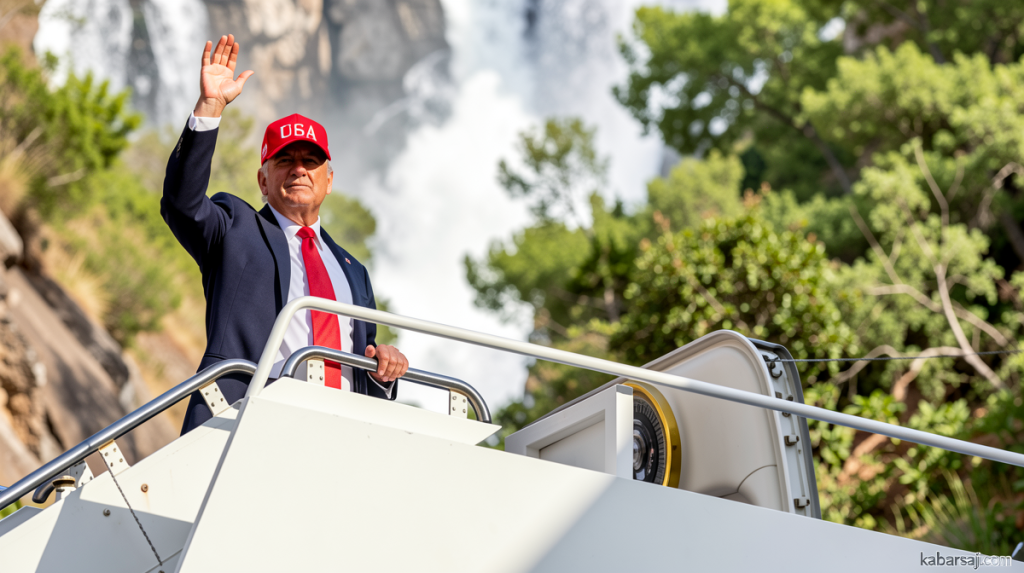
Between Two Giants: Malaysia’s Balancing Act Under Strain
Kabarsaji.com – Southeast Asia’s geopolitical fault lines are shifting, and no country feels the tremor more acutely than Malaysia. Prime Minister Anwar Ibrahim has made a point of telling the world, repeatedly and publicly, that Kuala Lumpur will not be dragged into picking a side in the escalating rivalry between Washington and Beijing. Yet a pair of remarks made in mid-August have forced observers to ask whether that middle path still holds, or whether the currents of great-power competition are finally pushing the nation toward one shore.
The Taiwan Statement That Sparked Alarm
In an interview with Al Jazeera broadcast on August 16, Anwar addressed the status of Taiwan with a bluntness that caught many in the region off guard.
“I see Taiwan as part of China, period.”
Beijing has long maintained that the island, which has been governed democratically since the late 1940s, is an inseparable province of the People’s Republic. Chinese leadership routinely speaks of preferring “peaceful reunification,” yet has never formally excluded the option of military force to achieve that end. Anwar went further than most Southeast Asian leaders typically do by appearing to endorse that option in principle.
“If one province decides to break away. Do we use force? I think I will, [to] protect the sanctity and unity of the nation.”
The reaction was swift and split along familiar lines. In Beijing, officials welcomed the remarks with evident satisfaction. Across the strait, Taiwan’s Foreign Ministry pushed back sharply, accusing Anwar of effectively green-lighting the use of force against the island. The ministry also warned that what it characterized as one-sided alignment with China could dampen Taiwanese business confidence in investing in Malaysia — a concern with real economic teeth, given that the island’s semiconductor industry is deeply embedded in the Malaysian supply chain.
Sabah, Balabac, and the Military Question
Just two days after the Taiwan interview aired, Anwar turned his attention to a different flashpoint: the Malaysian state of Sabah on the island of Borneo. He argued that Kuala Lumpur should bolster its own defensive posture there, pointing to the expansion of American-backed military installations on Balabac, a Philippine island sitting roughly 50 kilometers (31 miles) from the Malaysian outlying islands of Banggi and Balambangan.
Balabac was among four additional sites added in 2023 to the Enhanced Defense Cooperation Agreement (EDCA), a framework that permits U.S. forces to rotate through designated Philippine bases, build infrastructure, and pre-position equipment. For a government watching its own territorial waters, the proximity of a growing allied military presence is not an abstract concern.
Taken together, the two sets of remarks — warm toward Beijing’s territorial narrative, wary of Washington’s expanding footprint — fed a narrative that Malaysia was tilting eastward while growing more suspicious of its traditional Western partners.
Gaza Rhetoric and the Question of Realignment
Complicating the picture further, Anwar has been among the region’s most vocal critics of Israel’s conduct in Gaza. He has charged the United States and European governments with hypocrisy, arguing that they champion democracy and international law in the abstract while failing to hold Israel meaningfully accountable in practice. To some observers, that candor toward Western capitals reinforced the impression of a strategic pivot.
Malaysian scholars, however, urge caution against reading too much into the rhetoric.
“Malaysia still maintains very good relations with the US and other Western countries,” said Ngeow Chow Bing, director of the Institute of China Studies at Universiti Malaya. According to Bing, those ties may be less visible in public discourse than Anwar’s increasingly warm language directed at Beijing, but the underlying architecture of the relationship remains intact.
“It is certainly true that the space for maintaining its traditional balancing act between China and the US is narrower than before, but that space remains, and Malaysia will continue to operate within it.”
A Neighbor’s Claim, Not a Superpower’s
Chee Meng Tan, assistant professor at the University of Nottingham Malaysia, offered a different lens on the Sabah comments. In his reading, Anwar’s remarks were less about courting China than about an old, recurring territorial dispute between Kuala Lumpur and Manila.
The Philippines maintains a claim over Sabah, which entered the Malaysian federation in 1963. Malaysia rejects that claim outright and treats its sovereignty over the state as beyond question. The friction resurfaces periodically; in August, for instance, Kuala Lumpur lodged a fresh objection at the United Nations over a Philippine submission concerning its continental shelf.
“A neighbor that claims part of your territory is building a military base 20 minutes offshore — any government would react,”
Tan emphasized that Anwar called for strengthening Malaysia’s own defenses, not for Chinese military assistance, and that the prime minister went out of his way to affirm that relations with Manila remained good.
Walking Back the Temperature
Recognizing the diplomatic heat his initial remarks generated, Anwar moved quickly to lower the temperature. Speaking to Malaysian media after the Al Jazeera interview, he stressed that Kuala Lumpur wanted a peaceful resolution to cross-strait tensions and insisted that Malaysia’s position had not changed.
That position, formally, has been a “One China” policy maintained since Malaysia established diplomatic relations with Beijing in 1974. Chinese state media, unsurprisingly, interpreted Anwar’s remarks through Beijing’s preferred terminology, framing them as a reaffirmation of a settled principle rather than a new departure.
What remains clear is that the margins for quiet balancing are shrinking. Every new EDCA site, every semiconductor fab, every UN filing narrows the room in which a mid-sized Southeast Asian state can say “neither” without being heard as “both.” Malaysia’s challenge for the coming years is not whether it will choose a side, but whether it can keep choosing neither while the two giants press closer together.
Related Reading
Frequently Asked Questions
What is Malaysia s Middle Path Between China?
Malaysia s Middle Path Between China is the main topic of this guide. The article explains the context, practical details, and next steps readers should understand.
Why does Malaysia s Middle Path Between China matter?
Malaysia s Middle Path Between China matters because readers are looking for a useful answer, not just a short summary. Good content should match search intent and help them decide what to do next.