
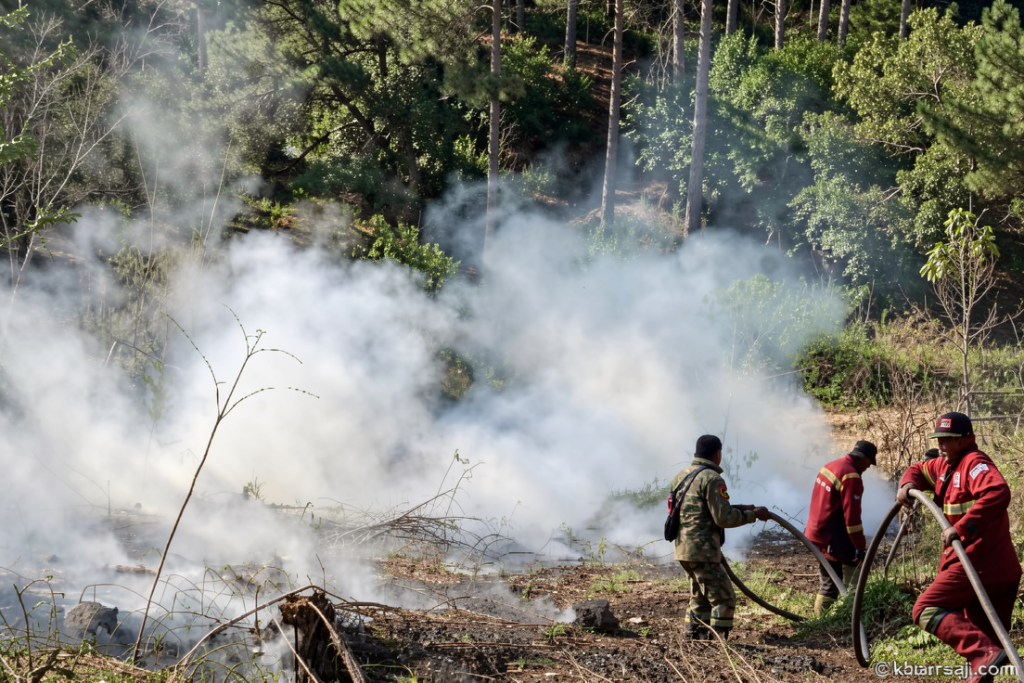
Indonesia’s Forest Fire Probe Expands: Police Now Tracking 89 Individuals Across Sumatra and Kalimantan
Kabarsaji.com – The Indonesian National Police has widened its net of suspects in the ongoing forest and land fire investigations, adding 17 new names to the roster since the cases were first opened in February 2026. The updated tally now stands at 89 individuals, all of whom are being treated as persons rather than corporate entities at this stage of the inquiry. The expansion reflects what investigators describe as a deeper, more granular sweep of field evidence gathered over recent weeks.
Brigadier General Mohamad Irhamni, who heads the Specific Crime Directorate within the Crime Investigation Department of the Indonesian National Police, confirmed the revised figure during a public statement delivered on Monday, September 1, 2026. He framed the increase as a natural consequence of teams working more thoroughly through each case file rather than closing investigations prematurely.
“So, the number (of suspects) has increased from yesterday,” Irhamni said.
From 72 to 89: What Changed
Before the latest additions, police had formally designated 72 suspects connected to fire incidents spanning nine provinces. Those provinces are Riau, West Kalimantan, South Sumatra, Jambi, Central Kalimantan, South Kalimantan, East Kalimantan, Aceh, and North Kalimantan — a geographic spread that underscores how widespread the ignition events have been across both major islands. The jump from 72 to 89 in a single reporting cycle signals that field units are still actively identifying additional individuals linked to specific burn sites.
Irhamni emphasized that investigators are not satisfied with stopping at the person who lit the match. He made clear that the police intend to follow the chain of command and financing upward, should evidence warrant it.
“If there is any evidence, no matter how small, that strengthens the fact that it was indeed ordered by a corporation, we will pursue and take action,” Irhamni added.
Burning as a Cost-Cutting Shortcut
At a press conference held at the National Police Headquarters in South Jakarta on Sunday, August 23, 2026, Irhamni offered a blunt explanation for why so many separate ignition events occurred in a compressed timeframe. In his assessment, land-clearing operators opted for open flame rather than deploying heavy machinery because the former is dramatically cheaper in the short term.
“The easiest way is by burning it,” Irhamni said.
That economic logic — trading a few days of labor and a match for weeks of mechanical clearing — has been a recurring driver of peatland and forest fires in tropical Southeast Asia. When dry seasons arrive and wind conditions shift, what begins as a small clearing burn can spread across thousands of hectares, generating the haze that periodically blankets Sumatra, Kalimantan, and neighboring countries.
Who Are the 89?
The majority of those now under investigation are small-scale farmers or day laborers hired to prepare plots for rice cultivation or oil-palm planting. Investigators are still determining whether each acted on personal initiative or received instructions, materials, and funding from a higher-level operator. That distinction matters because it separates a local agrarian decision from what would amount to a corporate directive executed at ground level.
Irhamni stressed that the police are intensively and proactively searching for every person who set a fire, rather than limiting the inquiry to the most visible or largest incidents.
“We are intensively and proactively looking for the perpetrators who set the fire,” Irhamni stated.
Corporate Dimension: 42 Companies Mapped in Kalimantan
While the police roster currently lists only individuals, the Ministry of Environment has been running a parallel corporate mapping exercise. Minister Mohammad Jumhur Hidayat disclosed that his ministry has identified 42 companies operating in Kalimantan that are suspected of triggering or failing to prevent the fires. Of those, roughly a dozen face strong suspicion of regulatory violations.
“This is for Kalimantan, the data for Sumatra is currently being updated,” Jumhur noted, as carried by the Antara news agency.
Jumhur indicated that his ministry will coordinate directly with police to address alleged criminal acts by the individuals who started the fires, while simultaneously applying administrative sanctions — including substantial fines — against corporations found to have breached environmental regulations. The dual-track approach means a single fire event could generate both a criminal case against the person who lit the burn and an administrative penalty against the entity that commissioned or benefited from the land clearing.
Why the Scale Matters
Indonesia’s forest and land fires have long carried consequences well beyond the affected provinces. Haze from large-scale burning has repeatedly disrupted air travel, strained public health systems, and drawn diplomatic friction with Singapore, Malaysia, and Thailand. The fact that investigators are now working across nine provinces simultaneously, and that the suspect count is still climbing, suggests the 2026 fire season has been unusually broad in geographic scope. For communities in Riau, Jambi, and the Kalimantan provinces, the question is no longer whether fires occurred but whether accountability will reach beyond the individual laborer to the entities that shaped the economic incentives behind each ignition.
As field teams continue to process evidence and the Ministry of Environment finalizes its Sumatra corporate data, the next reporting cycle could see both the suspect count and the list of penalized companies grow further.
Related Reading
Frequently Asked Questions
What is Indonesia Forest Fire Suspects Rise to 89?
Indonesia Forest Fire Suspects Rise to 89 is the main topic of this guide. The article explains the context, practical details, and next steps readers should understand.
Why does Indonesia Forest Fire Suspects Rise to 89 matter?
Indonesia Forest Fire Suspects Rise to 89 matters because readers are looking for a useful answer, not just a short summary. Good content should match search intent and help them decide what to do next.