
Indonesia Advances Digital Forest Monitoring With $4.83 Million MERANTI Initiative
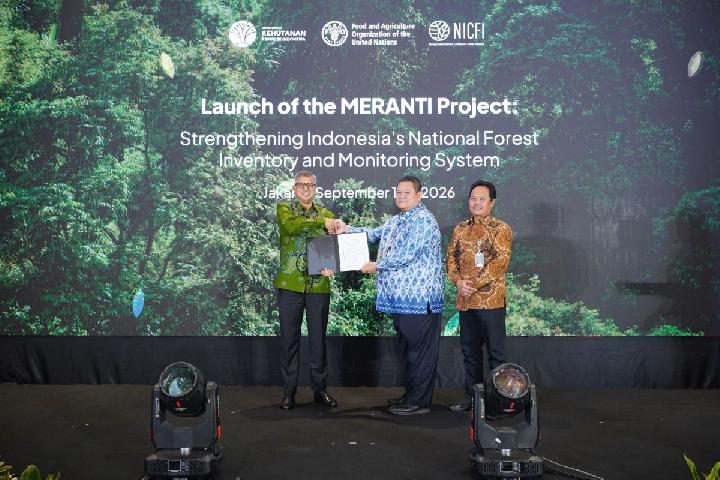
Kabarsaji.com – Indonesia is moving to strengthen the information base behind its forest protection and climate policies through a new US$4.83 million national monitoring project. The Ministry of Forestry and the Food and Agriculture Organization of the United Nations launched the initiative in Jakarta on Thursday, September 10, 2026, with financial support from Norway.
The program, named Monitoring and Enhancement of Remote Sensing for National Forest Inventory, or MERANTI, is intended to modernize the country’s National Forest Inventory and improve the integration of field observations with satellite-based analysis. The work is scheduled to continue from 2026 until 2028.
Forests remain central to Indonesia’s development and environmental agenda. The country has about 96 million hectares of forest, representing 51 percent of its land area, and contains the world’s third-largest tropical forest expanse. These ecosystems are recognized for their biodiversity and support the livelihoods of more than 40 million people.
Building a More Complete Picture of Forest Conditions
Indonesia has developed its National Forest Inventory over several decades with FAO technical assistance. MERANTI is designed to build on that foundation through an updated NFI 2.0 approach, digital tools, and more extensive use of remote sensing data.
The project aims to make forest information faster to collect and more dependable for decision-makers. It will also broaden data collection in locations that have been difficult to assess, including mangrove areas along the coast and forests managed by local communities.
Satellite imagery can provide wide coverage and frequent observations, but it does not replace information gathered directly on the ground. NFI 2.0 will provide detailed field-based reference data on matters such as tree species, biomass, soil conditions, and forest degradation. This type of ground-truth information helps make remote sensing assessments more accurate and useful.
A crucial prerequisite for sound forestry management is the availability of accurate, up-to-date, consistent, and reliable data. Forestry data serves as the foundation for policy formulation, development planning, monitoring of forest resource conditions, evaluation of forest management, and the preparation of various national and international reports.
Ade Tri Ajikusumah, Director General of Forestry Planning at the Ministry of Forestry, delivered the remarks during the project’s launch. The emphasis on consistent data reflects the broad role forest measurements play: they influence planning, management reviews, environmental reporting, and the ability to track changes across a large and geographically diverse country.
Climate Targets Raise the Stakes for Reliable Information
The initiative arrives as Indonesia works toward national and international climate commitments that depend heavily on land-use and forestry outcomes. Under its Enhanced Nationally Determined Contributions, Indonesia has committed to cutting greenhouse gas emissions by 31.89 percent by 2030 through its own efforts. With international assistance, that reduction target rises to 43.2 percent.
The forestry and other land use sector, often described as FOLU, is expected to contribute roughly 58 percent of the planned emissions reductions. That makes clear and credible forest data especially important. Reliable inventories can help establish what is happening in forests, guide policy choices, and support evaluations of whether management actions are delivering the intended results.
Better information may also support Indonesia’s access to results-based climate finance. Such financing is linked to demonstrable environmental outcomes, making transparent monitoring systems important for efforts to accelerate sustainable and low-carbon development.
Strong climate action depends on reliable data and evidence. Indonesia’s forest inventory and monitoring systems play a critical role in providing this foundation. This is why Norway supports the MERANTI. The project will modernize the National Forest Inventory and ensure better integration with the national forest monitoring system. Better and more reliable data strengthens Indonesia’s position in international climate cooperation and enhances evidence-based decision-making for sustainable forest and land-use management.
Esben Marcussen, Counsellor for Forest and Climate at the Royal Norwegian Embassy in Jakarta, said Norway’s support is tied to the value of stronger inventory and monitoring systems for climate cooperation and land-use decisions.
Field Surveys, Training, and a New Public-Facing Portal
FAO will assist with field data collection from at least 500 National Forest Inventory clusters across Indonesia. The resulting observations will be combined with satellite information to produce a more comprehensive analysis of forest resources and conditions.
The project includes technical training for government personnel involved in NFI implementation, data analysis, and quality assurance. Building these skills within Indonesian institutions is a core part of the effort, allowing expertise and operational capacity to remain in place after the project concludes.
A new National Forest Inventory web portal is also planned for integration with SIMONTANA, Indonesia’s existing National Forest Monitoring System platform. Linking the updated inventory process with the national monitoring system is expected to make forest information more accessible and better connected across government monitoring activities.
This is Indonesia’s system, and Indonesia’s data. Our part is to help strengthen it by bringing international experience, standards, and technical approaches; supporting the modernization of remote sensing and the national monitoring system; and, most importantly, transferring knowledge and building capacity that stays here in Indonesia, with Indonesian institutions and experts, long after the project ends.
Rajendra Aryal, FAO Representative in Indonesia and Timor-Leste, said the organization’s role is to support Indonesia’s own system while helping transfer technical knowledge, international standards, and practical monitoring approaches.
MERANTI complements other work being carried out by the Ministry of Forestry and FAO to improve forest monitoring. Its central objective is straightforward but consequential: ensure that national decisions about forests, climate action, and sustainable land use are grounded in information that is current, detailed, and trusted.
Related Reading
Frequently Asked Questions
What is Indonesia FAO Launch 4 8m Forest?
Indonesia FAO Launch 4 8m Forest is the main topic of this guide. The article explains the context, practical details, and next steps readers should understand.
Why does Indonesia FAO Launch 4 8m Forest matter?
Indonesia FAO Launch 4 8m Forest matters because readers are looking for a useful answer, not just a short summary. Good content should match search intent and help them decide what to do next.