
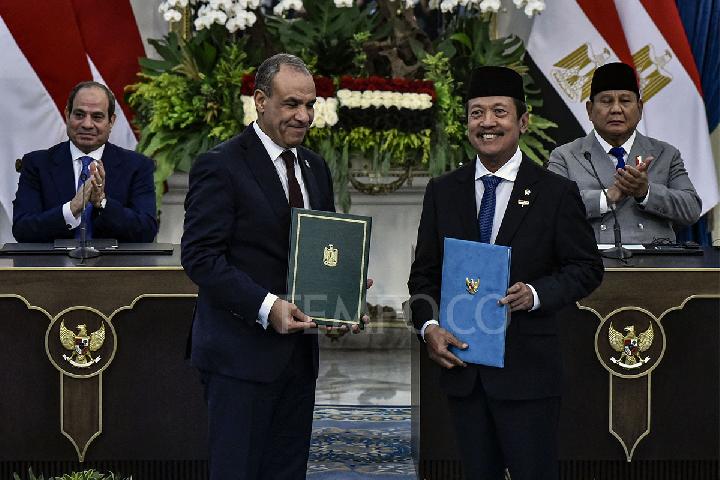
Indonesia and Egypt Set Broader Agenda for Strategic Cooperation
Kabarsaji.com – Indonesia and Egypt have outlined a wider framework for cooperation after President Prabowo Subianto hosted Egyptian President Abdel Fattah el-Sisi at Merdeka Palace in Jakarta on Sunday, October 11, 2026. Their discussions covered political engagement, trade and investment, maritime and fisheries issues, and defense collaboration.
The visit produced four memorandums of understanding and a shared commitment to develop closer institutional links between the two countries. The agreements point to an effort to turn high-level diplomatic relations into more regular cooperation involving government agencies, investment institutions, and sectoral partners.
After the bilateral meeting, Prabowo characterized the conversation with el-Sisi as detailed and constructive, emphasizing the significance of the Egyptian president’s visit for the relationship between Jakarta and Cairo.
Your Excellency’s visit this time marks an important milestone in strengthening our partnership,
Prabowo said the meeting examined a number of initiatives intended to deepen ties across several areas of common interest. Both leaders agreed that sustained contact between their governments would be important, including through routine meetings at senior levels and more effective use of established bilateral mechanisms.
Political Coordination and Bilateral Forums
On political matters, Indonesia and Egypt agreed to maintain close communication between their respective governments. Regular senior-level exchanges can help ensure that commitments made during presidential meetings are followed up by ministries and relevant institutions.
The two countries also plan to make fuller use of existing bilateral forums. Such channels provide a practical setting to discuss progress on shared programs, resolve implementation issues, and identify new opportunities for cooperation as priorities develop.
Indonesia and Egypt are major countries in Southeast Asia and the Middle East and North Africa, respectively. Their decision to reinforce political communication places emphasis on the long-term management of their strategic partnership rather than limiting engagement to individual state visits.
Trade, Investment, and a Proposed Economic Partnership
Economic ties formed a central part of the leaders’ agenda. Indonesia and Egypt agreed to strengthen cooperation in commerce and investment, with both sides supporting the creation of an Economic Partnership Agreement.
The proposed arrangement is intended to improve access to each other’s markets, open more avenues for investment, and encourage greater participation by businesses from both countries. A stronger economic framework could give companies clearer channels for pursuing commercial opportunities while supporting broader government-to-government economic engagement.
Prabowo also welcomed a proposal for a Joint Investment Fund involving investment institutions from Indonesia and Egypt. The planned fund would be aimed at supporting investment in projects regarded as strategic by the two sides.
I also welcome the initiative to establish a Joint Investment Fund by investment institutions from both countries to promote investment in strategic projects,
The fund proposal adds an investment-focused element to the economic agenda. Its eventual impact will depend on how the institutions involved define strategic projects, establish financing arrangements, and develop investable opportunities.
Maritime Affairs, Fisheries, and Marine Sustainability
Maritime and fisheries cooperation was another major area discussed at Merdeka Palace. Indonesia and Egypt agreed to expand joint work related to sustainable development, conservation of marine resources, efforts against illegal fishing, and the exchange of expertise and knowledge.
The focus on sustainable marine management reflects the importance of protecting fisheries and marine ecosystems while supporting activities connected with the sea. Cooperation on illegal fishing can also strengthen information-sharing and technical discussions between the relevant authorities.
Knowledge exchange may involve the sharing of experience, professional capacity, and approaches to maritime resource management. The signed agreement in this field provides a formal foundation for future work between Indonesia’s Ministry of Marine Affairs and Fisheries and the Arab Republic of Egypt.
Defense Industry and Human Resource Development
The leaders also agreed to widen defense cooperation. The agenda includes closer engagement in the defense industry as well as programs designed to strengthen human resources.
Collaboration in this sector may involve institutional exchanges and joint programs that develop professional capacity. The commitment signals that defense is being included alongside economic and maritime cooperation in the broader bilateral relationship.
Details of individual projects, timelines, and implementing arrangements were not outlined in the agreements announced following the meeting. The next stage will be shaped by follow-up work between the agencies and institutions responsible for each area.
Four Memorandums of Understanding
The meeting concluded with the signing of four cooperation documents. Together, they cover strategic partnership planning, travel facilitation for certain official passport holders, statistical cooperation, and maritime and fisheries collaboration.
Strategic Partnership Action Plan
The first memorandum of understanding was signed by Indonesia’s Ministry of Foreign Affairs and Egypt’s Ministry of Foreign Affairs. It concerns an action plan for the strategic partnership, giving the two foreign ministries a basis for organizing and tracking cooperation priorities.
Visa Exemption Arrangement
A second memorandum concerns visa exemptions for holders of diplomatic, service, and special passports. The arrangement applies to these specified categories of official travel documents rather than to ordinary passport holders generally.
Statistics Cooperation
The third memorandum of understanding addresses statistics. Cooperation in this area can support exchanges between institutions that collect, organize, and use data for public policy and economic planning.
Maritime and Fisheries Agreement
The fourth document concerns maritime affairs and fisheries. It was signed between Indonesia’s Ministry of Marine Affairs and Fisheries and the Arab Republic of Egypt, reinforcing the leaders’ stated interest in sustainable marine development, resource conservation, and action against illegal fishing.
The agreements signed in Jakarta provide a structured starting point for the next phase of Indonesia-Egypt relations. Their practical value will rest on continued political contact and on the ability of the responsible institutions to translate the shared commitments into active programs, investment initiatives, and sector-specific cooperation.
Related Reading
Frequently Asked Questions
What is Indonesia Egypt Ties?
Indonesia Egypt Ties is the main topic of this guide. The article explains the context, practical details, and next steps readers should understand.
Why does Indonesia Egypt Ties matter?
Indonesia Egypt Ties matters because readers are looking for a useful answer, not just a short summary. Good content should match search intent and help them decide what to do next.