
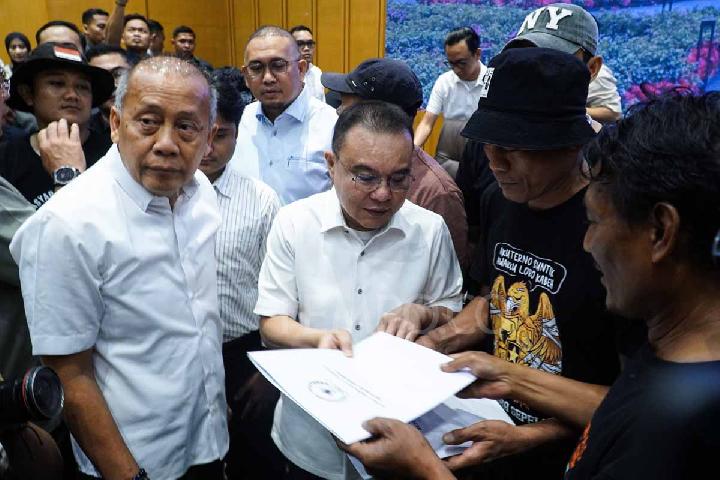
Midnight Phone Call to the Presidency: Inside the Quiet Negotiation That Calmed a Pati Protest
Kabarsaji.com – In the small hours past midnight on Wednesday, August 26, 2026, a group of twelve activists from Central Java sat across from four deputy speakers of Indonesia’s House of Representatives in the Delegation Room of the Nusantara III Building in Senayan, Jakarta. The conversation stretched well into the early hours of Thursday, August 27, and among its most consequential exchanges was a brief telephone conversation between Supriyono, a representative of the United Pati People’s Alliance (AMPB), and President Prabowo Subianto. The call lasted only a few minutes, yet it carried enough weight to shape the trajectory of a mass demonstration that had been scheduled for the following afternoon.
Prabowo, widely known by his nickname “Botok,” took the call on the mobile phone of House Deputy Speaker and Gerindra Party Executive Chair Sufmi Dasco Ahmad, who was present in the room. Supriyono used the short window to make two points directly to the head of state: the planned march by residents of Pati Regency was a genuine expression of popular aspiration, and no organized faction was steering or bankrolling the AMPB’s activities.
“No one was riding on our movement or financing it, not the Solo gang or any group in power,” Supriyono recalled saying to the President, as he recounted the exchange in an interview on Thursday, September 3, 2026.
The Protest That Nearly Reached Jakarta
The AMPB had organized a demonstration set to take place on Thursday afternoon, August 27, 2026, in the capital. Residents of Pati Regency, a district in Central Java, were mobilizing to press two specific legislative demands: the passage of a national Asset Forfeiture Bill and the imposition of the death penalty on those convicted of corruption. Supriyono told the President he would ensure the march proceeded peacefully, a promise that effectively removed the most immediate security concern for the government ahead of a large gathering in the capital.
A state official who was present in the Delegation Room during the late-night session confirmed that Supriyono had framed the AMPB’s position not as opposition to the government but as an attempt to assist it. In that official’s account, Supriyono told Prabowo that the Pati residents wanted to help the state fight corruption, and that their demands for stronger asset-recovery tools and harsher sentencing were offered in that spirit.
Why Asset Forfeiture Matters in Indonesia
The Asset Forfeiture Bill sits at the center of a long-running debate about how Indonesia recovers wealth siphoned through graft. Under existing criminal procedure, the state must first secure a full conviction before it can seize a corrupt official’s property. In practice, that requirement allows suspects to dissipate, transfer, or bury illicit gains before a trial concludes, often years after the alleged offenses. A dedicated forfeiture statute would permit the government to freeze and ultimately confiscate assets linked to corruption even while criminal proceedings are still underway, shifting the burden toward the accused to demonstrate that the property was lawfully acquired.
Indonesia’s anti-corruption agency, the KPK (Komisi Pemberantasan Korupsi), has long advocated for such a mechanism. The pairing of a forfeiture tool with a death-penalty provision for corruption, as demanded by the AMPB, reflects a broader public frustration that existing sanctions — typically prison terms and fines — fail to deter high-level graft or to return stolen wealth to the state treasury.
The Political Arithmetic of the Delegation Room
The meeting itself was notable for its composition. Supriyono arrived with eleven AMPB colleagues, and across the table sat Dasco alongside three other deputy speakers of the DPR. The configuration placed the activists in direct dialogue with the leadership of the legislature rather than with a single ministry or agency. Dasco, as both a deputy speaker and the executive chair of Gerindra — the party that anchors the ruling coalition — occupied a position where he could relay constituent pressure upward to the presidency while also signaling to the broader parliamentary caucus that the government was listening.
By fielding the call personally, Prabowo signaled that the protest was being treated as a matter of executive attention rather than a routine police-management issue. The timing — shortly after midnight, with the demonstration less than twenty-four hours away — underscored the urgency both sides felt. Supriyono and his eleven colleagues spent the remaining hours of the night briefing the four deputy speakers on the specific grievances of Pati residents and the conditions under which the AMPB would consider its demands met.
What the Midnight Exchange Changed
The practical effect of the conversation was to convert a potentially volatile street event into a structured political negotiation. Supriyono’s assurance of a peaceful march removed the pretext for a heavy security cordon that might have inflamed tensions. His insistence that no external actor was directing the AMPB neutralized a common government reflex: treating grassroots mobilization as a proxy operation of a rival faction. And his framing of the demands as assistance to the anti-corruption agenda gave the deputy speakers a diplomatic language with which to carry the issue into formal legislative channels.
Whether the Asset Forfeiture Bill will ultimately clear the DPR, and whether any death-penalty amendment will accompany it, remains an open question in the Indonesian legislature. What the midnight session in Senayan demonstrated, however, was that a small delegation of regional activists, armed with a clear legislative ask and a direct line to the presidency, could compress weeks of bureaucratic inertia into a single night of high-level dialogue — and walk away with a promise of peace for the streets of Jakarta the very next day.
Related Reading
Frequently Asked Questions
What is How Politicians Defused the Asset Forfeiture?
How Politicians Defused the Asset Forfeiture is the main topic of this guide. The article explains the context, practical details, and next steps readers should understand.
Why does How Politicians Defused the Asset Forfeiture matter?
How Politicians Defused the Asset Forfeiture matters because readers are looking for a useful answer, not just a short summary. Good content should match search intent and help them decide what to do next.