
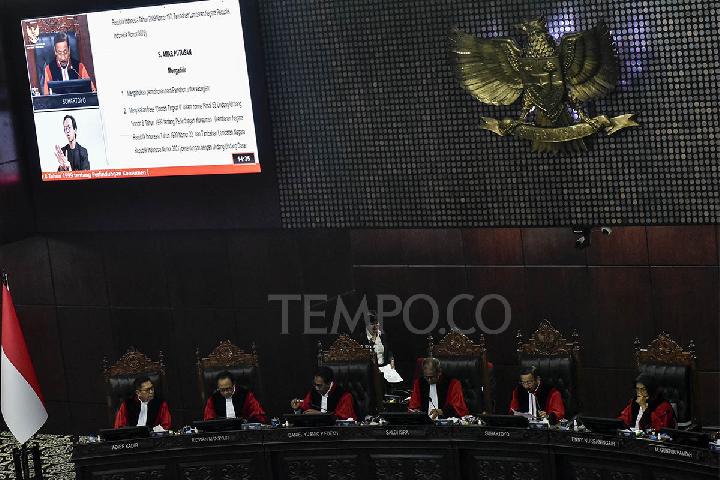
Ethics Complaints Target Constitutional Court Judges in Gibran Credential Case
Kabarsaji.com – Two Constitutional Court judges, Saldi Isra and Arsul Sani, are facing ethics complaints filed with the Constitutional Court Ethics Council, known as the MKMK, by the Gibran 08 Nusantara Militant Volunteer group. The complaints stem from a hearing connected to a challenge over the educational documents used by Gibran Rakabuming Raka in his 2024 vice-presidential candidacy.
Muhammad Rullyandi, a member of the volunteer group and a lecturer at Jayabaya University, submitted the complaint against the two judges. He had appeared as an expert witness in the presidential election dispute proceedings before the Constitutional Court.
I submitted the report [to the MKMK] and it was accepted by the MKMK Secretariat on Friday, October 2, 2026, at 2:50 p.m. WIB.
Rullyandi made the statement on Saturday, October 3, 2026. His complaint was lodged one day after he was removed from the evidentiary hearing while appearing for the relevant parties in the case.
Claims Against Saldi Isra and Arsul Sani
The complaint against Saldi Isra centers on allegations that the judge breached judicial ethics and conduct standards, particularly principles tied to fair treatment for all parties before the court. Rullyandi also argued that Saldi’s conduct interfered with academic freedom after the judge pressed him to retract a prior statement in which he described the hearing as illegal.
Arsul Sani was named in a separate allegation involving perceived partiality during his questioning of Rullyandi’s legal arguments. The ethics filing places both allegations before the MKMK, the body responsible for examining alleged misconduct by Constitutional Court justices.
This is an act that undermines constitutional norms.
The complaints arise in the middle of a politically sensitive dispute over Gibran’s qualifications. At issue is whether the educational credentials submitted in support of his vice-presidential nomination were legally valid. The petition does not merely concern a procedural disagreement at the hearing; it challenges documents tied to one of the country’s highest elected offices.
Separate Complaint Filed Against Chief Justice
Rullyandi also said a different ethics report had been filed against Constitutional Court Chief Justice Suhartoyo. That filing concerns Suhartoyo’s decision to continue the election dispute proceedings, which Rullyandi considers unlawful.
He further questioned Suhartoyo’s legal standing as chief justice, citing a previous lawsuit involving Suhartoyo at the State Administrative Court. Rullyandi said that complaint was submitted on October 1, 2026, at 10:01 a.m. WIB.
I filed that report on October 1, 2026, at 10:01 a.m. WIB.
The allegations against the chief justice are distinct from those directed at Saldi and Arsul, but all of them are linked by Rullyandi’s objections to how the credential dispute has been handled. An ethics complaint does not itself determine the outcome of the election case or establish that a judge has committed a violation. Its purpose is to ask the MKMK to assess whether judicial conduct complied with the standards governing the Constitutional Court.
Witness Removed From Oral Testimony
The confrontation that preceded the ethics filing took place during the hearing on Thursday, October 1, 2026. Saldi ordered Rullyandi to leave the courtroom after raising concerns about statements the witness had made during a talk show.
In those remarks, Rullyandi had called the trial over Gibran’s educational credentials illegal. Saldi asked him to withdraw that characterization, and Rullyandi complied. Even so, the court decided that his expert testimony would be received only in writing rather than heard orally.
You cannot present oral testimony. Thank you, you cannot convey anything else.
The decision meant that Rullyandi’s views could remain part of the case record in written form, while he was not permitted to elaborate on them directly before the justices in the courtroom. The distinction is important in a legal dispute because written testimony and oral testimony can play different roles in explaining an expert’s reasoning and responding to questions from the bench.
The Underlying Presidential Election Dispute
The case has been registered as No. 01/PHPU.PRES-XXIV/2026. It was filed by former Deputy Minister of Law and Human Rights Denny Indrayana together with 11 other petitioners.
The petitioners are contesting the legitimacy of the educational documentation that Gibran used to meet the requirements for his 2024 vice-presidential candidacy. Their challenge has brought questions about candidate eligibility, documentary proof, and court procedure into the same proceeding.
The dispute also highlights the central role of the Constitutional Court in resolving presidential election cases. Its hearings can determine how challenges to electoral eligibility are examined, which evidence is accepted, and whether arguments made by petitioners and their witnesses will be considered by the court.
For Rullyandi and the volunteer group, the focus has expanded beyond the credentials themselves to include the conduct of the judges overseeing the proceedings. For the court, the continuing case combines the task of evaluating the petitioners’ claims with the need to maintain confidence in the fairness and order of the hearing process.
A response from the Constitutional Court’s Head of Public Relations and Protocol Bureau, Pan Mohamad Faiz Kusuma Wijaya, had not been provided at the time the complaints became public. The next developments will depend on how the MKMK handles the ethics submissions and how the Constitutional Court proceeds with the underlying challenge to Gibran’s educational documents.
Related Reading
Frequently Asked Questions
What is Gibran Volunteers Report Constitutional Judges to MKMK?
Gibran Volunteers Report Constitutional Judges to MKMK is the main topic of this guide. The article explains the context, practical details, and next steps readers should understand.
Why does Gibran Volunteers Report Constitutional Judges to MKMK matter?
Gibran Volunteers Report Constitutional Judges to MKMK matters because readers are looking for a useful answer, not just a short summary. Good content should match search intent and help them decide what to do next.