
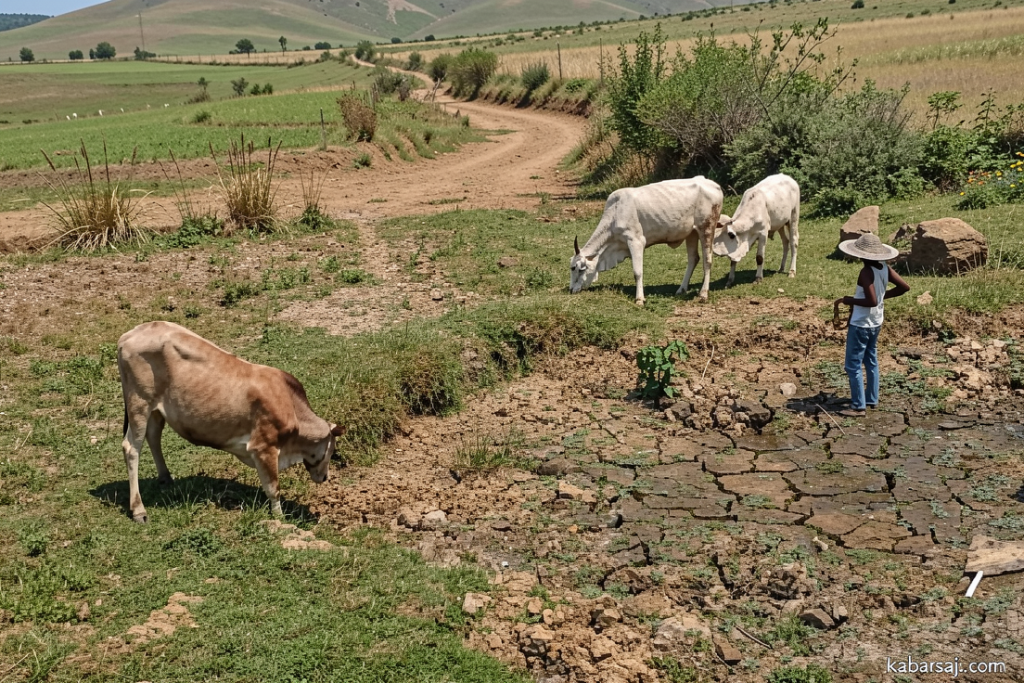
West Java Faces Deepening Drought as El Niño Intensifies Across the Archipelago
Kabarsaji.com – BMKG – More than four in ten square kilometers across West Java have gone without a single drop of rain for over two months, pushing the province into its most severe drought episode of the 2026 dry season. The Meteorology, Climatology, and Geophysics Agency (BMKG) confirmed on August 31, 2026, that 43 percent of the province’s monitored territory is now classified as experiencing extreme drought—defined as a continuous rainfall gap exceeding 60 days. That figure represents a six-percentage-point jump from July, signaling that the dry spell is accelerating rather than plateauing.
West Java, home to roughly 48 million people and a dense patchwork of rice paddies, tea estates, and urban centers, depends heavily on seasonal monsoon rains to sustain agriculture and municipal water supply. When the dry season stretches beyond its typical window, the consequences cascade quickly: reservoirs drain, wells run shallow, and fire risk climbs across both forested highlands and suburban waste sites.
Where the Rain Has Vanished
The BMKG West Java Climatology Station mapped the extreme-drought belt along the northern coastal strip, stretching from Bekasi and Karawang eastward through Subang, Indramayu, Cirebon, Kuningan, and Majalengka. Parallel dry zones have emerged in Sumedang, Sukabumi Regency, Cianjur, and the southern reaches of Garut. The most extreme single-location reading recorded to date sits at 100 consecutive rain-free days in Losari District, Cirebon Regency—a figure that places the area well beyond the threshold normally associated with agricultural crop failure.
A further six percent of the province falls into the “very long drought” category, where rainfall gaps span 31 to 60 days. Those pockets are scattered across portions of Pangandaran and Bogor Regency. At the opposite end of the spectrum, roughly a quarter of West Java still registers brief dry spells of only one to five days, concentrated in Bogor Regency and City, Depok, the Karawang–Subang border zone, Purwakarta, West Bandung Regency, and central Cianjur. Bandung City, Sumedang, Tasikmalaya Regency, and Pangandaran continue to receive regular rainfall, though the overall trend points toward contraction of those wetter zones.
El Niño Tightens the Grip
The meteorological driver behind the prolonged dryness is a strengthening El Niño event. Rossian Nursiddiq, a weather forecaster at BMKG West Java, cited the latest global climate analysis showing the El Niño index has climbed to +2.3—an extreme reading that suppresses convective cloud formation over much of western Indonesia. With atmospheric stability rated light to moderate across the region, the probability of organized rainfall has dropped sharply.
“The potential for light rain is still predicted to occur locally in some areas of West Java,” Nursiddiq said in an official statement on Monday, August 31, 2026, adding that rainfall during the first ten days of September 2026 is expected to remain low and below normal.
For farmers in the northern coastal regencies—many of whom grow maize, cassava, and horticultural crops on rain-fed plots—the forecast carries immediate practical weight. Without supplemental irrigation, a second consecutive month without meaningful rainfall risks total crop loss for the current planting cycle.
Forest Fires Multiply
The drought’s most visible secondary effect has been a surge in land and forest fires. Teten Ali Mulku Engkun, head of West Java’s Regional Disaster Management Agency (BPBD), reported 132 fire incidents across the province through August 24, 2026, consuming an estimated 196.40 hectares of vegetation. The incidents are spread across 19 regencies and cities, 91 sub-districts, and 153 villages or urban wards.
“The intensity of the incidents has been increasing since June,” Teten stated, noting that authorities are heightening vigilance because the peak of the dry season may not subside until September.
Most fires have ignited on dry land, in shrubland, grasslands, litter accumulations, waste disposal sites, and other easily flammable vegetation. Human activity remains the dominant ignition source—cigarette butts, open waste burning, and slash-and-burn land clearing account for the majority of starts. Teten pointed to a specific example: on August 9, 2026, a waste-burning fire in Subang Regency spread uncontrollably and destroyed two hectares of bamboo plantation.
Half a Million Residents Short of Water
The human toll of the drought is substantial. BPBD records show that, as of August 24, 2026, 588,534 people—equivalent to approximately 181,484 households—across 440 villages and urban wards in 189 sub-districts are affected by water scarcity. Bogor Regency alone accounts for 200,743 of those residents. Other heavily affected areas include Bekasi Regency (72,165 people), Purwakarta Regency (49,593), Bandung Regency (31,769), Tasikmalaya Regency (29,014), Sukabumi City (31,037), and Karawang Regency (24,315).
In response, provincial and district authorities have mobilized tanker trucks and temporary storage tanks to deliver clean water to affected communities. Teten confirmed that cumulative clean-water distribution across West Java has reached 13 million liters as of the reporting date. Given the scale of the shortfall, officials anticipate continued reliance on emergency water convoys through at least the first half of September, should the El Niño-driven suppression of rainfall persist.
For West Java’s agricultural sector, the coming weeks will determine whether the 2026 dry season ends as a manageable shortfall or escalates into a full-blown water crisis. With the El Niño index still at extreme levels and no reliable monsoon onset forecast before late September, provincial planners are preparing contingency protocols for both fire suppression and water rationing in the most vulnerable northern and eastern regencies.
Related Reading
Frequently Asked Questions
What is BMKG?
BMKG is the main topic of this guide. The article explains the context, practical details, and next steps readers should understand.
Why does BMKG matter?
BMKG matters because readers are looking for a useful answer, not just a short summary. Good content should match search intent and help them decide what to do next.