Modi and Putin Highlight India-Russia Ties Ahead of BRICS Meeting
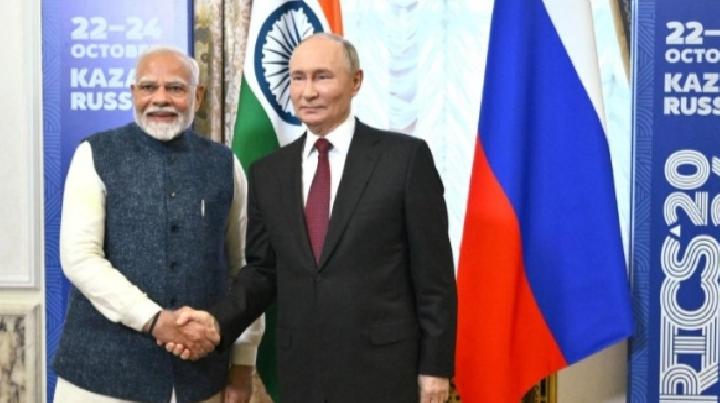
Kabarsaji.com – Indian Prime Minister Narendra Modi and Russian President Vladimir Putin used a bilateral meeting ahead of the BRICS Summit to underline the continuing importance of relations between New Delhi and Moscow. Their talks took place on the margins of the gathering, which is set to begin on Saturday, as India prepares to hold the BRICS chairship in 2026.
The discussion covered cooperation between India and Russia in multilateral forums, with particular attention to BRICS during India’s upcoming leadership of the group. The two governments also addressed regional and international developments affecting their shared interests.
Among the issues raised were conflicts in West Asia and the Black Sea region. Both areas have had consequences for shipping routes, maritime commerce, and the safety of Indian seafarers working at sea. The subject reflects the wider concern among trading nations over instability along important maritime corridors.
The leaders also renewed their intention to deepen what both countries describe as their Special and Privileged Strategic Partnership. India and Russia have maintained extensive political, economic, and diplomatic contacts over decades, while continuing to coordinate in international organizations on issues where their interests overlap.
“Remain engaged” in strengthening the Special and Privileged Strategic Partnership.
India’s 2026 BRICS Chairship
India’s chairship in 2026 will place New Delhi in a central position as BRICS manages a larger and more diverse membership. The forum began with Brazil, Russia, India, and China before South Africa joined, creating the name by which the grouping became widely known. Its membership has expanded significantly since the decision to admit more countries in 2023.
BRICS now includes 11 members, alongside partner countries. The expansion has broadened the group’s reach across regions and strengthened its claim to represent perspectives often described as part of the Global South. At the same time, a wider membership has made agreement more difficult on sensitive geopolitical questions.
For India, leading BRICS in 2026 will involve balancing the interests of countries with different foreign-policy priorities, security relationships, and economic ambitions. The task is not simply administrative. The chair can shape meeting agendas, encourage areas of common action, and seek language that members can support even when they disagree on major international disputes.
Modi’s meeting with Putin therefore came at a moment when India is preparing for a more prominent role within the organization. Maintaining dialogue with Russia is one element of that preparation, particularly as BRICS debates trade, development, financial cooperation, and responses to global instability.
A Larger Bloc, but Not Always a Unified One
Former United Nations diplomat Shashi Tharoor has argued that BRICS has become more representative of the Global South as its membership has increased. The group’s enlargement brought together states with markedly different geopolitical positions, including Iran as well as Egypt and Ethiopia, which have strategic relationships with the United States.
“In some ways the expansion has made it much more the voice of the global south.”
That broader representation gives BRICS greater political weight, especially when discussions focus on the concerns of emerging economies and developing countries. It also means the organization brings together governments that may see international crises in very different ways.
Tharoor has pointed to this tension as a defining feature of the expanded grouping. A larger BRICS may speak for a wider share of the world’s population and economic interests, but it can also struggle to produce common language on divisive matters. The difficulty is especially clear when member states confront conflicts involving countries with different security partnerships or competing diplomatic priorities.
“BRICS is functioning, but the contradictions remain.”
During this year’s leaders’ meeting, members were unable to settle on agreed wording for every issue, resulting in India issuing a chair’s statement rather than a fully shared declaration on certain points. Tharoor noted that disagreements extended beyond Iran and also involved Ukraine.
The outcome illustrates a practical reality for BRICS: consensus remains central to its political value, yet consensus becomes harder as the group includes more governments with divergent interests. The organization does not erase those differences; instead, it provides a setting where they must be managed through negotiation.
Maritime Security and Regional Conflict
The reference by Modi and Putin to West Asia and the Black Sea highlights how regional wars can quickly produce wider economic and humanitarian effects. Commercial shipping depends on predictable sea lanes, while seafarers face direct risks when conflict threatens ports, vessels, or nearby waters.
For India, maritime safety is an important concern because Indian nationals work across the international shipping industry and the country relies heavily on overseas trade. Disruptions in major shipping routes can affect delivery times, freight costs, insurance pressures, and the security of crews.
Russia’s role in Black Sea developments and its broader international engagement make these conversations relevant to India’s diplomatic efforts. The bilateral meeting showed that the two leaders are prepared to discuss the consequences of regional conflicts alongside their broader agenda for cooperation.
What the Meeting Signals
The Modi-Putin talks reaffirmed that India and Russia intend to preserve close engagement while BRICS enters a new phase. Their focus on multilateral coordination, maritime concerns, and strategic ties signals that bilateral diplomacy will remain connected to the wider debates taking place inside the expanded bloc.
As India approaches its 2026 chairship, it will face an organization with greater reach but also sharper internal differences. The challenge for New Delhi will be to build agreement where possible while recognizing that BRICS members will not always share a single position on the world’s most contentious issues.
Related Reading
Frequently Asked Questions
What is BRICS Summit 2026?
BRICS Summit 2026 is the main topic of this guide. The article explains the context, practical details, and next steps readers should understand.
Why does BRICS Summit 2026 matter?
BRICS Summit 2026 matters because readers are looking for a useful answer, not just a short summary. Good content should match search intent and help them decide what to do next.