
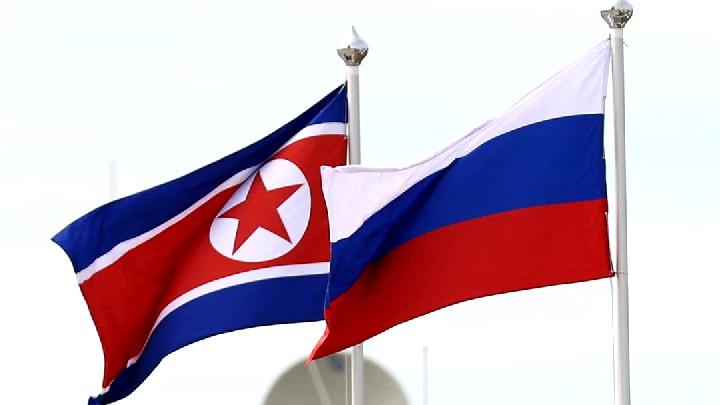
First Road Link Between Russia and North Korea Opens Across the Tumen River
Kabarsaji.com – For more than six decades, the Tumen River has served as a natural border between Russia and North Korea, crossed only by a single railway span built in the aftermath of the Korean War. That era ended on Monday when Moscow and Pyongyang jointly inaugurated the first-ever road bridge connecting the two nations, a milestone that transforms a long-standing gap in their bilateral transport network into a functioning highway corridor.
The new crossing sits in close proximity to the Friendship Bridge, the rail link commissioned in 1959 that has carried trains between the two countries for over sixty years. Until this week, travelers and freight moving between Russia and North Korea by land were limited to that single rail artery, supplemented by air routes. The absence of a dedicated road connection had constrained the volume and flexibility of cross-border commerce, tourism, and personnel movement for decades.
A Name Carrying Historical Weight
The structure bears the name of Yakov Novichenko, a Soviet Red Army officer recognized for having saved the life of Kim Il Sung, the founder of North Korea’s ruling dynasty, during the Korean War era. The naming decision underscores how Pyongyang and Moscow continue to frame their partnership through shared wartime memory. Members of Novichenko’s family were present at the ribbon-cutting ceremony, lending the event a personal and symbolic dimension beyond standard diplomatic protocol.
From Agreement to Completion in Under a Year
The project moved from political agreement to physical construction with unusual speed. Russian President Vladimir Putin visited North Korea in 2024, during which trip the two governments reached consensus on building the road crossing. Groundwork commenced in April 2025, meaning the bridge went from political commitment to operational status in roughly nine months. That compressed timeline reflects the priority both capitals have placed on completing the infrastructure before the broader strategic relationship matures further.
Mishustin Frames the Bridge as an Economic Catalyst
Prime Minister Mikhail Mishustin addressed the opening ceremony by video link, positioning the new crossing as a lever for multiple sectors of the bilateral economy. His remarks, carried by the TASS news agency, emphasized the multiplicity of benefits expected from expanded cross-border mobility:
“I am convinced that the expansion of cross-border transport infrastructure will provide a powerful impetus for the further development of trade, economic, scientific, technological and cultural cooperation.”
The language is deliberately broad. By invoking scientific, technological, and cultural cooperation alongside trade, Mishustin signals that the bridge is intended to serve not merely commercial freight but also academic exchanges, joint research programs, and cultural tourism. For a region where cross-border road traffic had been nonexistent, even modest volumes of passenger and cargo movement represent a qualitative shift in daily interaction between the two populations.
Geopolitical Backdrop: A Partnership Forged in War
The road bridge arrives at a moment when Moscow and Pyongyang have moved far beyond the cautious, often distant relationship that characterized much of the post-Cold War period. Since Russia launched its full-scale invasion of Ukraine in February 2022, the two governments have deepened coordination across military, economic, and diplomatic domains. North Korea dispatched thousands of troops to Russia’s Kursk region in 2024 to assist Russian forces in repelling a Ukrainian incursion, a deployment that represented one of the most visible manifestations of the renewed alliance.
The transport infrastructure now being completed sits within that broader architecture. Rail and air links already existed, but the addition of a road bridge removes a structural bottleneck and creates a third, independent corridor. In practical terms, this means that goods, workers, and visitors no longer depend on a single rail line or scheduled flights to cross the border. Redundancy in transport infrastructure reduces vulnerability to disruption and lowers the marginal cost of cross-border interaction.
Regional and Strategic Implications
The Tumen River basin has long been a zone of overlapping interests. South Korea, Japan, and China all maintain economic and diplomatic stakes in the region, and the physical hardening of Russia-North Korea connectivity along this stretch of border carries implications that extend well beyond bilateral trade volumes. A functioning road corridor facilitates not only commercial traffic but also the movement of military logistics, diplomatic personnel, and humanitarian supplies, all of which can be routed more flexibly than through a single rail span.
For local communities on both banks of the Tumen, the bridge introduces the prospect of cross-border tourism, small-scale trade, and labor mobility that had been structurally impossible before. The economic effects will unfold gradually, constrained by visa regimes, customs procedures, and the broader sanctions environment surrounding both countries. Yet the physical infrastructure now exists, and its mere presence alters the calculus for businesses, travelers, and policymakers on either side of the river.
The opening of the Novichenko Bridge thus marks more than an engineering achievement. It represents the materialization of a political commitment made during Putin’s 2024 visit, executed at a pace that signals genuine urgency, and embedded within a strategic partnership that has been tested and reinforced by the ongoing war in Ukraine. The road now runs where only tracks and runways once did, and the daily reality of life along the Tumen border will be shaped by that fact for years to come.
Related Reading
Frequently Asked Questions
What is Russia Opens First Road Bridge?
Russia Opens First Road Bridge is the main topic of this guide. The article explains the context, practical details, and next steps readers should understand.
Why does Russia Opens First Road Bridge matter?
Russia Opens First Road Bridge matters because readers are looking for a useful answer, not just a short summary. Good content should match search intent and help them decide what to do next.