
Indonesia Steps Up Airport Checks Following Lombok Gold Smuggling Cases
Kabarsaji.com – Indonesia’s Customs and Excise Directorate General is increasing scrutiny of baggage carried by international passengers after authorities uncovered two alleged attempts to take gold out of the country through Zainuddin Abdul Madjid Airport in Central Lombok, West Nusa Tenggara.
The two cases involved a combined 5.29 kilograms of gold with an estimated total value of Rp13.1 billion. Officials said the strengthened checks at international arrival and departure points are intended to curb illicit commodity movements and safeguard the country’s economic interests.
Sunaryo, head of the Customs and Excise regional office covering Bali, NTB, and NTT, said closer coordination is central to the effort. The agency wants cross-border commerce to proceed within the law while protecting the public from the effects of illegal trade.
“We hope to strengthen the synergy to protect the people and realize lawful cross-border trade,” Sunaryo said during a Tuesday press conference at Lombok Airport.
Concerns Over Gold Supply and Market Stability
Gold is a high-value commodity that can be moved in compact forms, making passenger baggage inspections an important part of export enforcement. Sunaryo said unauthorized gold shipments could affect domestic availability, price stability, and government downstream programs.
Authorities view tighter supervision of gold exports as necessary to ensure that trade in the precious metal follows applicable rules and delivers benefits to Indonesia’s national economy. The focus is not only on detecting prohibited items at a checkpoint, but also on ensuring that goods leaving the country have met export requirements.
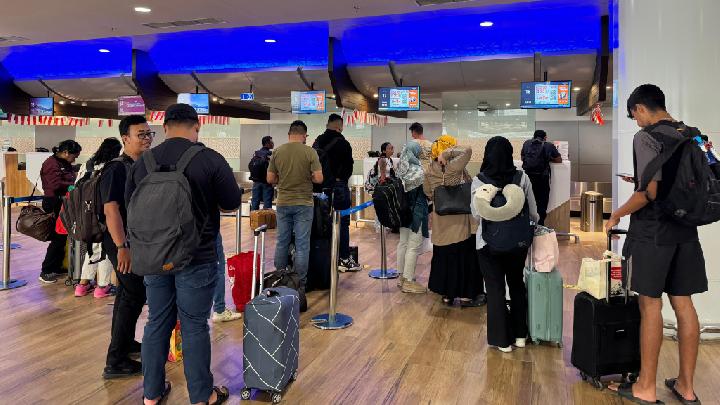
International airports serve as key gateways for travelers and commercial activity. In this setting, customs officers monitor luggage, travel patterns, documentation, and other indicators that may point to an attempted violation. The Lombok cases illustrate how inspections can involve both large bullion shipments and smaller jewelry items.
Four Gold Bars Bound for Hong Kong
The larger case involved four gold bars with a combined weight of 5,003.6 grams. Their estimated value was Rp12.4 billion, while potential state losses were put at Rp1.2 billion.
Zaeni Rokhman, head of the Mataram Customs and Excise Office, said officers became suspicious of a passenger identified by the initials CGS. The traveler was scheduled to fly to Singapore on Scoot Air flight TR259, transit there, and then continue to Hong Kong on Singapore Airlines flight SQ-874.
Officers ultimately discovered the four bars, weighing roughly five kilograms in total. The passenger has been named a suspect and is being held at the Class 2A West Lombok Prison.
“The passenger has been designated as a suspect and is currently being detained at the Class 2A West Lombok Prison,” Zaeni stated.
The case was among two gold-smuggling incidents disclosed by the Mataram Customs and Excise Office on October 3, 2026. Its scale underscores why authorities are paying particular attention to precious-metal shipments concealed or carried by departing passengers.
Gold Bracelets Found in a Backpack
A separate incident involved gold bracelets weighing 294.2 grams. The jewelry was estimated to be worth about Rp732 million, with potential state losses of Rp73 million.
The bracelets were found in a backpack carried by a Chinese passenger identified as ZY while the traveler was passing through the international departure checkpoint at Lombok Airport. Though far smaller than the bullion shipment in the other case, the jewelry still represented a substantial value and was treated as an alleged smuggling attempt.
Together, the two incidents show the different forms in which gold can be transported: refined bars in a large-volume case and wearable jewelry in another. For customs authorities, both require careful assessment because the relevant export rules apply regardless of whether gold is carried as bullion or personal accessories.
The broader enforcement push places greater emphasis on passenger baggage at international terminals. Travelers carrying valuable commodities should ensure that their goods, declarations, and export arrangements comply with Indonesian regulations before departure. Clear documentation and adherence to customs procedures can help distinguish legitimate travel and trade from activity that may trigger enforcement action.
For Indonesia, preventing unregulated exports is also tied to maintaining oversight of valuable domestic resources. The government’s concern extends beyond individual seizures to the potential impact that uncontrolled gold outflows may have on supply, prices, and industrial policy. The Lombok airport cases have now prompted a more focused approach to surveillance at the country’s international border points.
Related Reading
Frequently Asked Questions
What is Indonesia Tightens Airport Surveillance After Smuggled?
Indonesia Tightens Airport Surveillance After Smuggled is the main topic of this guide. The article explains the context, practical details, and next steps readers should understand.
Why does Indonesia Tightens Airport Surveillance After Smuggled matter?
Indonesia Tightens Airport Surveillance After Smuggled matters because readers are looking for a useful answer, not just a short summary. Good content should match search intent and help them decide what to do next.