
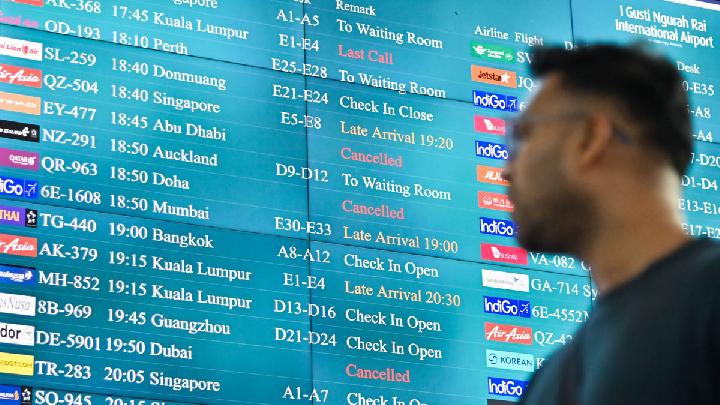
AirNav Indonesia and Boeing Plan New Approach to Increase Bali Airport Capacity
Kabarsaji.com – AirNav Indonesia is pursuing a plan to raise the hourly aircraft movement capacity at I Gusti Ngurah Rai International Airport in Bali, one of the country’s busiest aviation gateways. The initiative, developed with Boeing, is intended to improve the flow of arriving and departing flights while strengthening safety and operational efficiency.
The two organizations signed a Letter of Intent on Tuesday, September 15, 2026, at the Sheraton Hotel Jakarta Soekarno-Hatta Airport in Tangerang. Their work will focus on identifying practical ways to manage higher traffic volumes at Bali Airport, where infrastructure limitations make the coordination of aircraft movements particularly important.
AirNav Indonesia currently handles 33 aircraft movements per hour at the airport. Its longer-term target is to reach 40 movements an hour, with intermediate gains expected as new procedures are studied and tested.
“We currently manage 33 movements, but later that can be increased to 34, [even] 40 movements per hour,” AirNav Indonesia CEO Capt. Avirianto Suratno said.
Addressing a Challenging Airport Layout
A key factor behind the project is the layout of I Gusti Ngurah Rai Airport. The airport does not have parallel taxiways, even though it serves substantial flight traffic. That condition can make aircraft sequencing more complex, as arriving and departing planes may need to use shared operating areas at different stages of their journeys.
Pushback activity is also part of the challenge. When aircraft leave their parking positions, ground controllers must ensure that this movement does not interfere with aircraft taxiing for departure or arriving at their gates. Better coordination of these movements could help reduce congestion while keeping safety margins intact.
“This condition causes potential overlaps where departing and arriving aircraft share the same space, including during the pushback process,” Avirianto said.
The planned assessment will not treat every aircraft in the same way. Different types of aircraft require different handling times. Wide-body aircraft, for example, can have different movement characteristics from narrow-body jets, making the order and timing of departures especially significant during busy periods.
For passengers, the project’s purpose is not simply to place more flights into the schedule. The broader goal is to make existing airport and airspace operations work more predictably. Improved traffic management can support smoother aircraft movement on the ground and in the air, while allowing operators to assess whether delays, fuel use, and emissions can be reduced.
One-Year Study Combining Live Data and Simulation
AirNav Indonesia Operations Director Setio Anggoro said the joint project is expected to take roughly one year. The first stage will establish a detailed picture of current operations. From there, the partners will design alternative procedures and compare the potential results with the existing baseline.
The review will cover more than runway and taxiway activity. It will also consider airspace operations, reflecting the need to coordinate aircraft from the moment they approach Bali through their departure sequence.
“The scenario design applies not only to ground movements, but also to airspace operations,” Setio said.
Each side will contribute its own technical capabilities. AirNav Indonesia will use visualization tools that help monitor operating conditions in real time. Boeing will provide modeling technology capable of simulating aircraft traffic flows under different scenarios.
Simulation gives the partners an opportunity to test proposed changes digitally before they are introduced into active operations. That means potential procedures can be evaluated without disrupting live flights, allowing planners to examine how revised sequencing or movement patterns may affect the airport system.
“With this modeling, new scenarios can be digitally simulated without disrupting live flight operations,” Setio said.
The results will be assessed against the current operating baseline. The analysis is expected to measure possible changes in hourly capacity, time efficiency, fuel consumption, and reductions in carbon dioxide emissions. A procedure that increases capacity would therefore need to demonstrate not only that it can accommodate more movements, but also that it can do so safely and efficiently.
Building on a 2023 Cooperation Framework
The new Letter of Intent follows a Memorandum of Understanding signed by AirNav Indonesia and Boeing in 2023. That earlier agreement established a foundation for cooperation in airspace management, technical training, and strategic planning for air traffic.
Boeing Indonesia Managing Director Indra Duivenvoorde said the Bali study combines the company’s international experience in aircraft performance and air traffic management with AirNav Indonesia’s operational knowledge.
The intended outcome is a set of data-based, workable options for improving traffic flow and runway use. The project also places emphasis on aviation operations that are safe, efficient, and sustainable, rather than treating higher traffic capacity as an isolated objective.
“We view Indonesia as one of Asia’s largest aviation markets and are committed to our partnership with AirNav Indonesia and the national civil aviation sector,” Indra said.
Potential Model for Other Airports
If the approach proves successful at Bali Airport, AirNav Indonesia sees potential for it to be adapted at other Indonesian airports with similar constraints. Many airports in the country operate with a single runway or do not have parallel taxiways, conditions that can limit how efficiently aircraft are moved during high-demand periods.
“Most airports across Indonesia still operate with a single runway or lack parallel taxiways,” Setio said.
Any wider application would depend on the particular conditions at each airport, including its runway configuration, aircraft mix, traffic patterns, and surrounding airspace. Still, the Bali project could provide a framework for testing operational improvements before costly physical infrastructure changes are considered.
For Bali, the year-long study will determine whether carefully redesigned procedures and advanced traffic modeling can help the airport move closer to its target of 40 aircraft movements per hour while maintaining the safety standards required for a heavily used international airport.
Related Reading
Frequently Asked Questions
What is AirNav Boeing Partner to Boost Bali?
AirNav Boeing Partner to Boost Bali is the main topic of this guide. The article explains the context, practical details, and next steps readers should understand.
Why does AirNav Boeing Partner to Boost Bali matter?
AirNav Boeing Partner to Boost Bali matters because readers are looking for a useful answer, not just a short summary. Good content should match search intent and help them decide what to do next.