UGM Students to Carry Out Microgravity Research in Germany
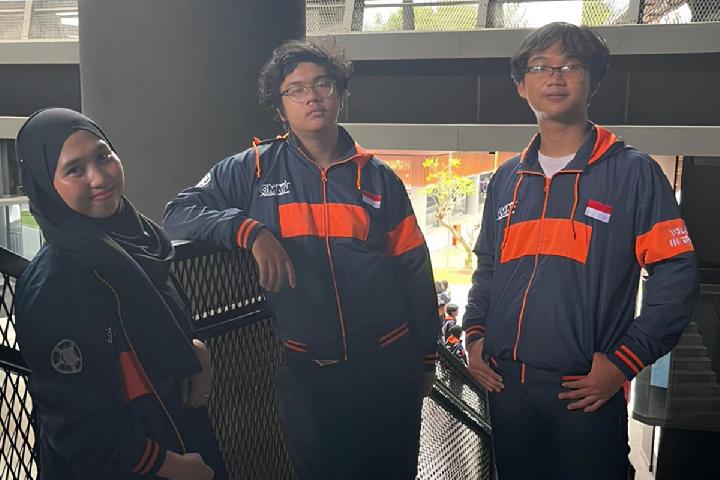
Kabarsaji.com – A student team from Universitas Gadjah Mada will take an Indonesian research project into a unique low-gravity testing environment in Germany after being chosen for the 10th Fellowship Programme for Drop Tower Experiment Series, known as DropTES.
The group’s work will examine how partly wet silica sand shifts and spreads when it is shaken under microgravity conditions. Although the material is studied on Earth, the findings may prove useful for future missions that need to collect, process, or transport soil-like materials on the Moon, Mars, and other destinations beyond Earth.
The opportunity gives the UGM team access to facilities in Bremen that are typically used by specialist researchers and engineers. Their experiment will be conducted at ZARM’s Bremen Drop Tower and GraviTower Bremen Pro, which provide researchers with ground-based microgravity environments without requiring a spaceflight.
Studying wet granular material beyond Earth
Granular materials such as sand can behave differently when gravity is greatly reduced. On Earth, gravity strongly influences how particles settle, pile up, slide, and react to vibration. In a microgravity setting, those familiar patterns may change, creating engineering challenges for spacecraft, landers, robotic systems, and exploration equipment.
The UGM project focuses specifically on moist granular matter. This subject has practical relevance because material resembling soil may need to be excavated, moved, sorted, stored, or delivered through machinery during planetary exploration. Data from controlled experiments can support the design of robotic digging systems, sample-transfer equipment, and material-handling technologies for off-world operations.
Understanding particle movement is especially important where crews or robotic vehicles may rely on local materials. Lunar and Martian surface material can present difficult handling conditions, and researchers need reliable information before developing systems intended to operate in environments where ordinary Earth-based assumptions may not apply.
The researchers will design, assemble, and test their own experiment through the fellowship. The programme therefore offers more than access to infrastructure: it provides students with direct involvement in the full experimental process, from preparing the research concept to observing the results under microgravity.
An international programme for emerging space communities
DropTES is organized jointly by the United Nations Office for Outer Space Affairs, or UNOOSA, and the Center of Applied Space Technology and Microgravity at the University of Bremen, widely known as ZARM. The German Aerospace Center, DLR, supports the initiative.
The fellowship is part of UNOOSA’s Access to Space for All initiative, which is intended to widen access to space research infrastructure and help strengthen scientific and technical capacity in nations building their space programmes.
UNOOSA Director Aarti Holla-Maini described the programme as a way to make advanced research opportunities more accessible to capable teams around the world.
“Scientific talent is everywhere, but access to opportunities is not. Programmes like DropTES help close that gap, giving teams from countries with emerging space capabilities the chance to turn their ideas into real experiments,” Holla-Maini said.
She welcomed the Indonesian team’s selection and expressed appreciation for the continuing cooperation of ZARM and DLR in making space research opportunities available to a broader range of participants.
ZARM Director Marc Avila also congratulated the UGM researchers, highlighting the connection between their work and the practical needs of future exploration projects.
“Their project addresses an important challenge for future space exploration by investigating how moist granular materials similar to lunar and Martian soil behave under microgravity conditions,” Avila said.
Building Indonesian research experience
For UGM, the fellowship creates a hands-on learning opportunity in a field that can be difficult to access through conventional laboratory work. Microgravity experiments often require specialized infrastructure, and the Bremen facilities allow students to investigate physical processes in conditions that cannot be sustained in an ordinary classroom or laboratory.
UGM Director of Student Affairs Hempri Suyatna said the programme would enable Indonesian students to gain practical experience in microgravity research and space exploration. The university expects the experience to encourage further innovation while helping students contribute to the advancement of Indonesian space science and technology.
The current selection places UGM among teams from a range of countries that have participated in DropTES since the programme began in 2014. Across its first nine rounds, the fellowship supported experiments from Bolivia, Colombia, Costa Rica, Italy, Jordan, Poland, Romania, and Venezuela.
The fellowship awarded immediately before UGM went to Universidad Central de Venezuela. Its researchers examined how microgravity affects the welding of aluminum alloys, demonstrating the programme’s wide scope, from the behavior of loose materials to manufacturing processes relevant to space environments.
UGM’s experiment adds another perspective to that body of work. Rather than concentrating on a single piece of machinery, it considers the movement of many small particles and the effects of moisture and controlled shaking. Those details matter when engineers must make equipment dependable in unfamiliar conditions.
The Bremen testing campaign will give the Indonesian team an opportunity to turn a research proposal into an experiment conducted in a real microgravity facility. Its results may help deepen scientific understanding of wet granular materials while giving the students experience that can support future research ambitions in Indonesia’s growing space science community.
Related Reading
Frequently Asked Questions
What is Indonesian UGM Team Selected for UN Microgravity?
Indonesian UGM Team Selected for UN Microgravity is the main topic of this guide. The article explains the context, practical details, and next steps readers should understand.
Why does Indonesian UGM Team Selected for UN Microgravity matter?
Indonesian UGM Team Selected for UN Microgravity matters because readers are looking for a useful answer, not just a short summary. Good content should match search intent and help them decide what to do next.