
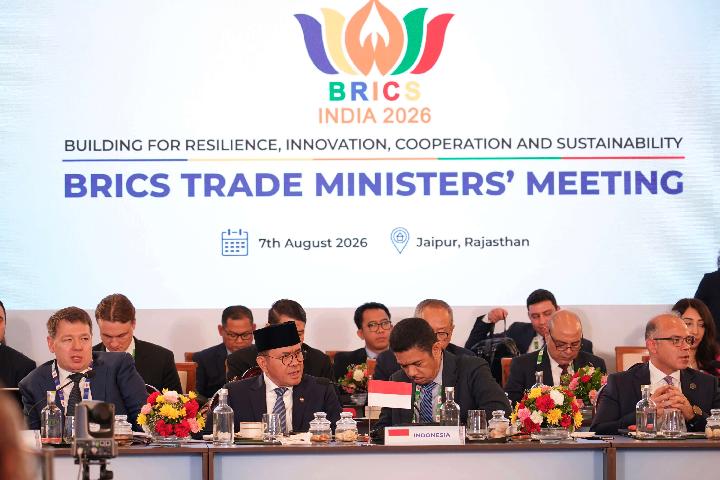
Does BRICS Have a Clear Purpose in India?
Kabarsaji.com – Does BRICS Have a Clear Purpose? As India prepares to host the 18th BRICS summit in Delhi, it is seeking to give the expanding group a practical, less confrontational agenda. The summit theme, “Building for Resilience, Innovation, Cooperation and Sustainability,” recasts the BRICS initials as a shared mission and offers language that can unite both longstanding and newer members.
BRICS began with Brazil, Russia, India, China and South Africa. Egypt, Ethiopia, Indonesia, Iran and the United Arab Emirates are among its newer participants. India’s emphasis on resilience, innovation, cooperation and sustainability is intended to show that the forum can be defined by common priorities rather than only by its membership list.
“It’s an elegant way to reinterpret BRICS so that the acronym represents a joint mission rather than country names,” Mihaela Papa, director of the BRICS Lab at the Massachusetts Institute of Technology, told DW.
India’s balancing act at the Delhi summit
India occupies an important position in shaping the summit’s tone. It has close defense ties with the United States, broad trade interests with Western economies, and a leading role in BRICS alongside China and Russia. This gives New Delhi an incentive to concentrate on economic cooperation and reform of global institutions, rather than allow the bloc to become an explicitly anti-Western alliance.
India has presented BRICS as a forum through which the Global South can pursue common interests. Prime Minister Narendra Modi has also stressed a people-centered approach and the principle of “humanity first.” But Does BRICS Have a Clear Purpose when its members differ sharply on international conflicts, security and trade? Converting broad themes into joint action will remain difficult.
“India doesn’t want to offend Russia or China, but the fact is that Indians are looking more towards the United States these days. The desire to build up BRICS is not there,” said Sushant Singh, a lecturer in South Asian Studies at Yale University.
Diplomacy beyond the formal agenda
The Delhi meeting has greater geopolitical significance than the previous summit in Rio de Janeiro, where six of the bloc’s 11 heads of state were absent, including Chinese President Xi Jinping and Russian President Vladimir Putin. Putin is expected in Delhi, while Xi is widely anticipated, although Beijing had not formally confirmed his attendance.
High-level Chinese participation matters because China is BRICS’ largest economic power and because relations between Beijing and New Delhi remain strained. The gathering could create an opportunity for direct discussions between Xi and Modi. Modi and Putin are also scheduled to meet on Friday, demonstrating how BRICS summits can facilitate bilateral diplomacy alongside their official program.
“The participation of China’s top leadership is crucial,” Papa said.
Iranian President Masoud Pezeshkian is expected to attend, while UAE President Sheikh Mohamed bin Zayed Al Nahyan is expected to send representatives. Saudi Arabia, whose membership status remains unclear despite appearing in official materials as a member, is also expected to be represented. Bringing regional rivals into the same forum may itself be valuable, though attendance cannot remove their underlying strategic differences.
Scale does not guarantee a unified direction
BRICS is nearing its 18th year with substantial demographic and economic weight. Its members account for nearly half of the world’s population and about 40 percent of global GDP. That scale gives the group influence in debates over international finance, trade, development and the representation of emerging economies.
Last year’s declaration urged changes to global governance, including greater representation in institutions such as the International Monetary Fund and the World Bank. It also criticized tariffs and warned about growing polarization in the global order. Such positions can draw support across emerging economies, particularly on development finance and institutional representation.
Yet Does BRICS Have a Clear Purpose beyond these broad ambitions? The group’s reach is undeniable, but its members’ competing interests can make agreement difficult. Its effectiveness may depend less on sweeping declarations than on whether it can produce practical cooperation while preserving space for dialogue among countries with very different priorities.
Frequently asked questions
What is India trying to achieve through the BRICS summit?
India is promoting resilience, innovation, cooperation and sustainability as common priorities. The approach aims to keep BRICS focused on development, economic cooperation and reform of global institutions.
Why is China’s participation important?
China is BRICS’ largest economic power, and its senior leadership’s presence would strengthen the summit’s political importance. It could also provide an opening for direct engagement with India despite strained bilateral relations.
Can BRICS act as a unified bloc?
BRICS can speak collectively on issues such as development finance and representation in global institutions. However, its members hold differing views on trade, security and international disputes, which can limit agreement on more contentious matters.