
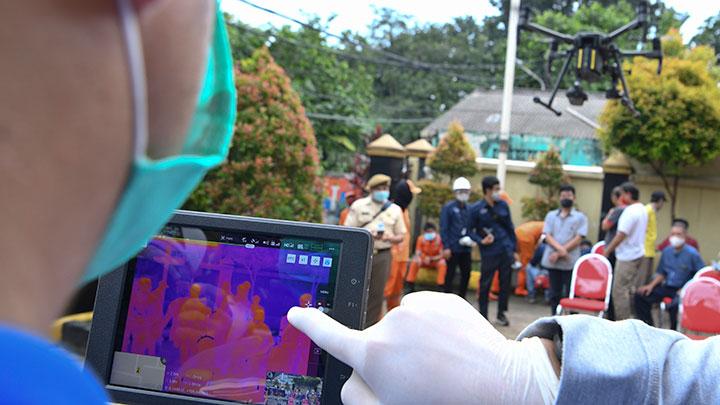
Thermal Drones Prepared for Search Near Mount Anak Krakatau
Kabarsaji.com – Search and rescue personnel in Banten are preparing to use thermal drones as efforts continue to locate journalists who lost contact while traveling by speedboat toward Mount Anak Krakatau. The group departed from Pegedongan Pier in Carita, Pandeglang Regency, but their subsequent whereabouts remain unknown.
The next phase of the operation is scheduled to begin at 07:00 WIB, provided weather and sea conditions allow teams to return safely to the search area. A coordinated response is being maintained at sea and on land, with rescuers also checking whether the missing boat may have reached smaller islands or isolated piers.
“We are ready to resume the search at 07:00 WIB (Western Indonesian Time),” Rizky said.
Volcanic Ash Limits Conventional Aerial Searches
Rizky Dwianto, the SAR Operations Coordinator, said helicopters and fixed-wing aircraft cannot yet be used because volcanic ash from Mount Anak Krakatau is still spreading in the area. Ash conditions can make air operations unsafe and reduce the effectiveness of visual searches from above.
Instead, the operation plans to deploy two thermal drones carried by the KN SAR Tetuka. The equipment is intended to give the team an aerial perspective around Mount Anak Krakatau while avoiding the current limitations affecting larger aircraft.
“We have equipped the KN SAR Tetuka with drones. We plan to fly them near Mount Anak Krakatau to conduct an aerial search using thermal drone technology,” he said.
Thermal drone technology can assist teams by detecting differences in heat, adding another tool to a search that is otherwise heavily dependent on visibility, sea conditions, and access to the surrounding waters. Its planned use reflects the operational challenges created by the volcano’s ash and the open-water environment around the island.
Night Operation Paused as Weather Deteriorated
Rescuers had continued searching with the KN SAR Tetuka until approximately 22:00 before bringing the vessel into Ciwandan Port in Cilegon. The decision followed worsening conditions at sea and poor nighttime visibility.
“Sea conditions were quite rough, and visibility was limited. So, we docked for the sake of effectiveness and safety,” Rizky said.
The pause was intended to protect personnel and ensure that the next deployment could be conducted under conditions more suitable for a sustained search. Maritime searches in waters near volcanic islands can be affected quickly by changing waves, darkness, haze, and reduced sightlines.
The operation includes two speedboats, RIB 02 Banten, the KN SAR Tetuka, and a rigid inflatable boat from Lampung. Search teams are also working with relevant authorities and local contacts to investigate possible landings at islands or piers that may not be routinely monitored.
“We are coordinating with relevant parties regarding the possibility that the boat docked at small islands or piers that are not under surveillance,” he said.
Information suggesting that the journalists could be on Sebesi Island is still being checked. Their presence there has not been confirmed, leaving the search area and possible routes under active review.
Joint Resources Placed on Standby
Local fishermen will be involved to strengthen the operation, bringing practical knowledge of nearby waters and possible docking points. The Banten SAR command post has prepared five primary assets from several participating institutions for deployment when required.
Those resources include the KN SAR Tetuka and RIB 02 Banten from Basarnas Banten, an RIB from Basarnas Lampung, the KAL Anyer from the Banten Naval Base, and an ambulance operated by FBN Banten. The combined marine and land support has been kept ready to support movement, medical response, and field coordination.
The personnel effort brings together 16 agencies and community groups. The teams include six members from USS Pandeglang, six from the Banten SAR Office, and eight crew members from KN SAR Tetuka. Carita Sector Police has deployed five personnel, while the Banten Regional Police Water and Air Police Directorate has assigned five more.
Additional support includes two personnel from the Sumur/Labuan Naval Post, two from the National Police Headquarters Water and Air Police Directorate, one Carita Village military officer, one Public Order Agency officer, and the head of Sukajadi Village. Seven Banten SAR volunteers and 50 Balawista lifeguards are also involved.
Carita District administration has assigned five people, while local media has seven participants in the wider response. Fishermen and residents are participating as well, extending the network of people able to observe coastal areas, small landing points, and nearby waters.
Focus Remains on Safe, Coordinated Search Coverage
With conventional aircraft temporarily unavailable, the planned drone deployment is expected to become an important part of the morning search effort. Teams will combine vessel-based patrols, local coordination, and aerial thermal imaging while continuing to assess conditions around Mount Anak Krakatau.
The operation remains focused on locating the journalists and tracing the speedboat’s possible route after it left Carita. Confirmation of any sighting or possible landing location will be essential before search resources can be redirected or narrowed to a specific area.
Related Reading
Frequently Asked Questions
What is Basarnas to Deploy Thermal Drones in Search?
Basarnas to Deploy Thermal Drones in Search is the main topic of this guide. The article explains the context, practical details, and next steps readers should understand.
Why does Basarnas to Deploy Thermal Drones in Search matter?
Basarnas to Deploy Thermal Drones in Search matters because readers are looking for a useful answer, not just a short summary. Good content should match search intent and help them decide what to do next.