
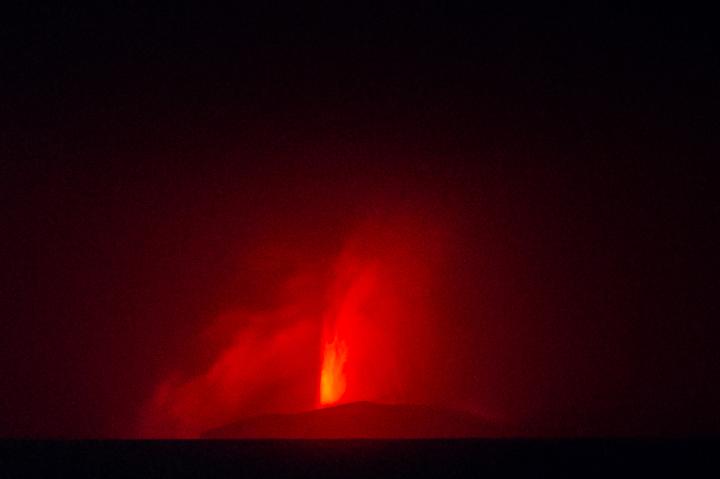
Anak Krakatau’s Prolonged Eruption Episode Concludes After 25 Hours of Sustained Activity
Kabarsaji.com – The young volcanic island of Anak Krakatau, rising from the shallow waters of the Sunda Strait between Java and Sumatra, has returned to its more familiar rhythm of discrete Strombolian bursts following a sustained eruptive episode that lasted roughly a full day. Indonesia’s Geological Agency, operating under the Ministry of Energy and Mineral Resources (ESDM), confirmed on Monday that the continuous eruption phase officially closed at 00:04 WIB on Sunday, September 6, 2026, bringing to an end a period of unbroken volcanic output that had begun at 23:07 WIB on Friday, September 4.
The distinction between a “continuous eruption” and the volcano’s baseline Strombolian behavior matters to both scientists and the communities living along the strait’s shores. A continuous episode implies that magma is being expelled in an uninterrupted column or fountain, often accompanied by sustained ash columns and elevated seismic energy. Strombolian activity, by contrast, produces discrete, rhythmic explosions at intervals of minutes to hours, ejecting incandescent clots of lava and smaller fragments. The shift back to the latter pattern signals that the pressurized pulse driving the sustained episode has dissipated, though it does not guarantee quiet ahead.
What the Instrument Record Shows
In the 48 hours following the episode’s conclusion (September 6–7, 2026), the agency’s monitoring network captured a dense catalogue of seismic signals: three eruption earthquakes, nine emission earthquakes, 93 low-frequency events, 98 hybrid or multi-phase earthquakes, four episodes of continuous tremor, and one shallow volcanic earthquake. The sheer volume of hybrid and low-frequency events suggests that magma is still migrating through the conduit system, grinding against rock walls and generating the characteristic mixed-frequency signatures.
The Real-time Seismic Amplitude Measurement (RSAM) trace, which had surged sharply on September 5 during the height of the continuous episode, began trending downward from September 6 onward. That decaying amplitude curve is consistent with the waning of the sustained eruptive phase. On the ground-deformation side, the tiltmeter at Tanjung Station registered a mild inflation beginning in early August 2026, hinting at gradual magma recharge into the shallow reservoir. The Lava93 tiltmeter, positioned closer to the vent, displayed a flat, constant reading over the same interval, indicating no sudden volumetric change at the immediate conduit level.
Official Assessment and Public Guidance
Lana Saria, head of the Geological Agency, outlined the interpretation in an evaluation report received in Jakarta on Monday. She emphasized that while the prolonged eruptive mode has ceased, the volcano remains energetically active and further eruptions in the coming days or weeks are quite probable.
“Following the end of that episode, Mount Anak Krakatau’s volcanic activity has transitioned back to Strombolian eruption characteristics, marked by the recording of three Strombolian-type eruption earthquakes,” Lana said.
On the basis of the full instrumental picture, the agency has retained the volcano at Activity Level III (Alert / Siaga), the second-highest tier in Indonesia’s four-level volcanic alert scale. At this level, routine Strombolian explosions are expected, and occasional larger events cannot be ruled out.
The agency issued a clear directive to the public: no one should approach, hike near, or conduct any activity within a three-kilometer radius of the active crater. Within that zone, hazards include ballistic ejection of hot rock fragments, ground-hugging pyroclastic flows, short-runout lava flows, and locally heavy ashfall capable of reducing visibility and depositing abrasive particulate on vegetation and structures.
For residents of the coastal districts in Banten and Lampung provinces—communities whose livelihoods depend on fishing and whose settlements sit within sight of the island—the agency urged calm and specifically asked people to disregard circulating rumors linking the eruption to a tsunami threat. Anak Krakatau sits in a strait roughly 200 metres deep; while a flank collapse could theoretically generate a local tsunami, the current eruptive style (Strombolian to continuous) does not produce the rapid, large-volume displacement required for such an event. Separately, anyone spending time outdoors during periods of ash transport is advised to wear a mask to protect the respiratory tract from fine volcanic particulate.
Why Anak Krakatau Deserves Sustained Attention
Anak Krakatau (“Child of Krakatau”) first appeared in 1927, decades after the cataclysmic 1883 eruption of the parent Krakatau island that killed some 36,000 people and generated one of the largest tsunamis on record. Since then the island has grown, eroded, and re-erupted multiple times, making it one of the most dynamically active young volcanoes in the Indonesian archipelago. Its position in a narrow, busy shipping lane amplifies the operational stakes: ash clouds can disrupt air corridors over Jakarta and the surrounding islands, while any future flank instability would send waves toward densely populated coastlines on both sides of the strait.
The current Level III status, combined with the elevated hybrid-seismicity counts and the ongoing mild inflation at Tanjung, means that monitoring stations will continue logging data around the clock. For the thousands of vessels that transit the Sunda Strait daily, and for the fishing communities of Banten and Lampung, the message from Jakarta is straightforward: the worst of this particular episode is over, but the volcano is still talking, and listening remains essential.
Related Reading
Frequently Asked Questions
What is Indonesia Says Anak Krakatau s 25 Hour?
Indonesia Says Anak Krakatau s 25 Hour is the main topic of this guide. The article explains the context, practical details, and next steps readers should understand.
Why does Indonesia Says Anak Krakatau s 25 Hour matter?
Indonesia Says Anak Krakatau s 25 Hour matters because readers are looking for a useful answer, not just a short summary. Good content should match search intent and help them decide what to do next.