Bandung Rail Network Unaffected as Anak Krakatau Erupts Again
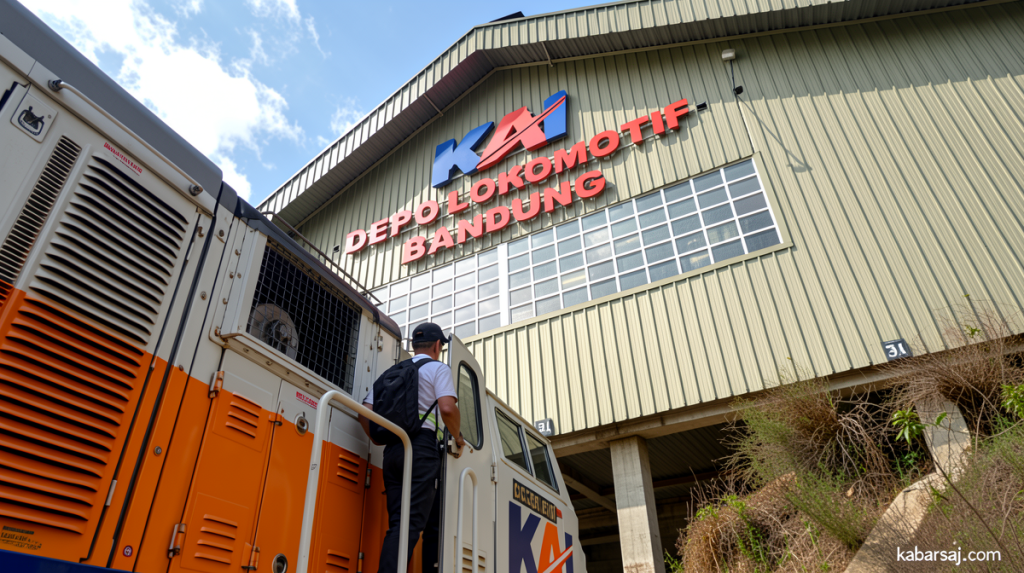
Kabarsaji.com – KAI – The Sunda Strait volcano Mount Anak Krakatau sent fresh plumes of ash and steam into the sky this week, reigniting concerns among residents and commuters along Java’s western rail corridors. Yet the operational backbone of West Java’s passenger rail system has held steady. PT Kereta Api Indonesia (Persero), specifically its Operational Area Two headquartered in Bandung, confirmed on Sunday that no disruption to scheduled services or station-level passenger handling has resulted from the renewed volcanic activity.
The announcement came from Kuswardojo, the Public Relations Manager assigned to Daop 2 Bandung, who addressed the question directly in a statement issued to the public. His message was unambiguous: trains are running on timetable, stations are processing passengers as usual, and the eruption has not introduced any operational variable into the network’s daily rhythm.
“We confirm that the urrent eruption activity of Mount Anak Krakatau has no impact on train operations or passenger services at stations within the Daop 2 Bandung region.”
Why the Question Matters
Mount Anak Krakatau sits roughly midway between the islands of Java and Sumatra in the shallow waters of the Sunda Strait, a location that places its ash fall and seismic tremors within reach of densely populated coastal and inland areas. The volcano has a long history of explosive episodes, most notably the 2018 flank collapse that generated a tsunami and killed more than four hundred people along the Lampung coast. For commuters in West Java, where the Bandung–Jakarta corridor carries hundreds of thousands of daily passengers, even a modest increase in volcanic output raises the question of whether ash deposits, ground shaking, or secondary hazards could compromise track integrity or signaling systems.
Daop 2 Bandung governs the rail infrastructure radiating from the city toward Jakarta, Garut, and other western destinations. Its lines traverse varied terrain, including sections that cross river valleys and elevated embankments where even minor ground disturbance warrants inspection. That is precisely why the company’s monitoring posture, rather than its current operational status, carries the greater weight for long-term planning.
Coordinated Vigilance with BMKG
Kuswardojo stressed that KAI is not operating in isolation. The railway company maintains an active coordination channel with the Badan Meteorologi, Klimatologi, dan Geofisika (BMKG), Indonesia’s national agency for meteorology, climatology, and geophysics. Through that channel, real-time data on eruption intensity, ash trajectory, and seismicity are cross-referenced against the rail network’s exposure points. The purpose is not to predict every tremor but to ensure that, should conditions shift, the railway’s response is informed and immediate rather than reactive.
The company has also reiterated its standing protocol: if any natural disturbance—whether volcanic, seismic, or meteorological—creates a condition that could endanger passengers or crew, train movements are suspended without delay. Personnel then conduct physical inspections of track geometry, ballast stability, signaling equipment, and rolling-stock condition. Services resume only after those inspections certify that no component has been compromised.
“The public need not worry, as every operational decision by KAI prioritizes safety. We ask the public to obtain information regarding train travel through KAI’s official channels and to avoid trusting unverified information.”
What Passengers Should Know
For the millions who depend on intercity rail between Bandung, Jakarta, and intermediate stops, the practical guidance is straightforward. Ticketing, boarding, and station services continue under normal parameters. Travelers are advised to check departure times and any service advisories through KAI’s official digital platforms—its mobile application, verified social-media accounts, and station information desks—rather than relying on unconfirmed social-media posts that circulate during periods of heightened public anxiety.
The broader context is worth noting. Indonesia sits along the Pacific Ring of Fire, and volcanic activity is a recurring feature of the national landscape rather than an anomaly. Railway operators across the archipelago maintain standing contingency plans for ash fall, lahars, and seismic events. Daop 2 Bandung’s current posture—operating normally while monitoring closely—reflects a mature risk-management framework rather than complacency. The distinction matters: a system that halts service at the first tremor erodes public confidence just as surely as one that ignores a genuine hazard.
Looking Ahead
Kuswardojo closed his statement with a forward-looking commitment. The company will continue tracking Anak Krakatau’s eruptive behavior and the surrounding environmental conditions that bear on rail safety. Should any development cross the threshold from monitored background activity to an operational threat, official communications will be issued promptly so that passengers, station staff, and coordinating agencies receive the same verified information simultaneously.
“KAI is always prepared to take well-coordinated measures prioritizing safety whenever there is a potential disruption threatening the safety of train travel.”
Until such a threshold is crossed, the trains between Bandung and its western and northern destinations will keep their schedules. The volcano will continue its restless work in the strait. And the railway, for now, will simply keep running.
Related Reading
Frequently Asked Questions
What is KAI?
KAI is the main topic of this guide. The article explains the context, practical details, and next steps readers should understand.
Why does KAI matter?
KAI matters because readers are looking for a useful answer, not just a short summary. Good content should match search intent and help them decide what to do next.