Mid-Hearing Power Shift Rattles Indonesia’s Oil and Gas Legislative Track
Kabarsaji.com – A routine energy-sector hearing in Jakarta’s parliament building turned into a sudden reshuffling of committee leadership on Wednesday, August 26, 2026, when three deputy speakers of the House of Representatives walked into the chamber mid-session and announced a chair replacement that had been brewing behind closed doors. The intervention, which came without prior notice to committee members, underscored how tightly the ruling Golkar Party is steering the legislative agenda around revisions to Indonesia’s foundational oil and gas statute.
The Hearing That Wasn’t
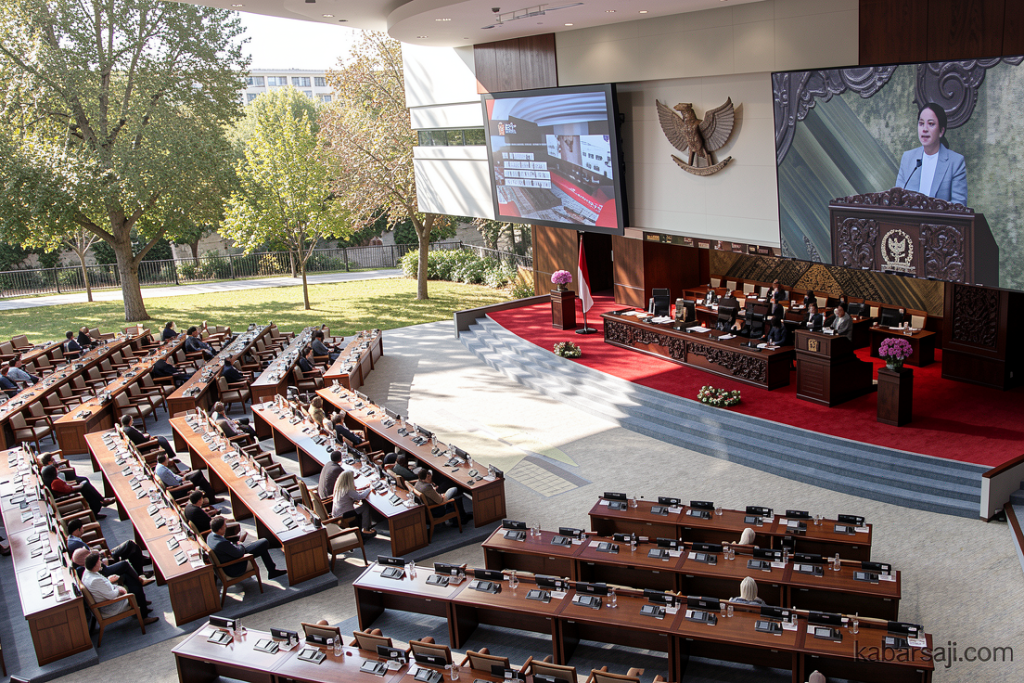
The session in question was a standard Commission XII briefing, in which senior officials from the energy and mineral resources portfolio were scheduled to answer questions about ongoing regulatory matters. Commission Deputy Chair Sugeng Suparwoto, who had been presiding over the proceedings in the chair’s absence, called a halt to the meeting roughly halfway through the agenda. Minutes later, the chamber door opened and three figures—Sufmi Dasco Ahmad, Saan Mustopa, and Sari Yuliati, all serving as deputy speakers of the House—strode to the leadership table and took their seats without explanation.
Dasco, speaking first, informed the assembled committee members that Bambang Patijaya, who had chaired Commission XII since November 4, 2024, was being removed from the post. In his place, Melchias Markus Mekeng, a veteran legislator representing the East Nusa Tenggara electoral district, would assume the chair. Both men belong to the Golkar Party, the largest faction in the current parliamentary majority.
“We received a letter from the faction,” Dasco told the committee, explaining the procedural basis for the swap.
He added that the letter had arrived on Tuesday, August 18, giving the committee less than a week’s notice before the change was enacted on the floor.
Why the Timing Matters
Commission XII is the parliamentary body responsible for energy policy, mineral resources, and the upstream hydrocarbons sector. Its mandate includes oversight of the Energy and Mineral Resources Ministry, the national oil company Pertamina, and the regulatory agencies that govern exploration, production, and downstream distribution. When the committee convenes to debate amendments to existing energy legislation, the chair’s role becomes pivotal: setting the agenda, managing witness testimony, and shaping the language of draft bills before they reach the plenary floor.
Law No. 22/2001, enacted during the early years of Indonesia’s post-Suharto democratic transition, remains the principal statute governing oil and gas activities. It established the framework for upstream licensing, production-sharing contracts, and the role of state-owned enterprises in the sector. Two decades and a half into its operation, the law has been the subject of repeated reform proposals, driven by shifting fiscal realities, declining domestic production, and pressure to attract new investment into mature basins.
Three officials who were present at the August 26 hearing confirmed that the chair replacement was directly connected to the renewed deliberations on amending that statute. According to those sources, the swap was executed at the explicit “direction” of Bahlil Lahadalia, who simultaneously holds the posts of Golkar Party General Chair and Minister of Energy and Mineral Resources. In other words, the minister who oversees the very sector under legislative review also wields the party whip that determines who sits in the chair of the committee tasked with rewriting the rules.
Mekeng’s Parliamentary Trajectory
Mekeng is not a new face in the legislature. Before his assignment to Commission XII, he served on Commission XI, the committee that oversees finance, banking, taxation, and state budget matters. That background gives him experience with fiscal instruments, sovereign debt, and the macroeconomic dimensions of energy policy—areas that intersect heavily with any overhaul of hydrocarbons law, particularly provisions touching on fiscal terms, tax incentives, and state revenue sharing from production.
His home district, East Nusa Tenggara, includes the island of Flores and surrounding territories where geothermal and hydrocarbon exploration have been active. A legislator with regional exposure to energy development may bring a different perspective to committee deliberations than one whose constituency is urban or agricultural.
Patijaya’s Tenure and the Faction Mechanism
Patijaya’s chairmanship lasted roughly twenty-one months, from November 4, 2024, to the August 2026 removal. During that period, Commission XII handled a full cycle of budget oversight, regulatory review, and at least one round of energy-sector legislative activity. His departure, however, was not the result of an internal committee vote or a performance review. It was, by Dasco’s own account, the implementation of a faction letter—a written directive from the Golkar parliamentary group instructing the leadership to effect the change.
In Indonesia’s parliamentary system, faction letters carry considerable weight. Because committee chairmanships are allocated among parties according to seat counts, and because intra-party discipline is enforced through such directives, a chair can be replaced without a formal vote of the committee itself. The deputy speakers’ physical presence in the chamber served to lend the announcement the procedural gravity of a plenary-level communication, even though the decision originated in a party office.
Implications for the Oil and Gas Reform Track
The speed with which the replacement was executed—eight days from the faction letter to the floor announcement—signals that the Golkar leadership views the oil and gas bill as a time-sensitive priority. Energy Minister Lahadalia’s dual role as party chair places him at the intersection of executive policy and legislative scheduling. Critics of the arrangement, while not publicly named in the hearing record, have long noted that concentrating both the regulatory agenda and the party whip in a single figure compresses the checks and balances normally expected between the executive and the legislature.
For industry stakeholders, the practical question is whether the new chairmanship will accelerate the bill toward a plenary vote within the current parliamentary session or whether it will open a second round of technical consultations. The hearing that was interrupted on August 26 was scheduled to resume, and committee members were expected to reconvene with the new chair in the coming days. The fate of Law No. 22/2001’s successor text now rests, in large measure, on how quickly Mekeng’s office can move the revised draft through committee markup and into the House agenda.
Indonesia’s downstream fuel supply, upstream production targets, and fiscal dependence on hydrocarbon revenues all make the timing of this legislative exercise consequential. A fast-tracked revision, if enacted without extended stakeholder consultation, could reshape contract terms for operators in mature fields, alter the balance of state and private participation in exploration, and recalibrate the tax and royalty architecture that funds a significant share of the national budget. The mid-hearing power shift of August 26, 2026, suggests that the ruling party intends to compress that timeline.
Related Reading
Frequently Asked Questions
What is The Fast Tracked Oil and Gas Bill?
The Fast Tracked Oil and Gas Bill is the main topic of this guide. The article explains the context, practical details, and next steps readers should understand.
Why does The Fast Tracked Oil and Gas Bill matter?
The Fast Tracked Oil and Gas Bill matters because readers are looking for a useful answer, not just a short summary. Good content should match search intent and help them decide what to do next.