
BYD’s Rp16 Trillion Bet on Indonesia: A 126-Hectare EV Plant Goes Live in West Java
Kabarsaji.com – The Indonesian government’s long-stated ambition to become a regional electric-vehicle manufacturing hub received its most concrete signal yet on Thursday, September 3, 2026, when BYD Co. Ltd. cut the ribbon on a Rp16 trillion (roughly US$1 billion) production complex in Cipeundeuy District, Subang Regency, West Java. The facility represents one of the largest single-plant automotive investments ever made in the archipelago and positions Indonesia squarely on the global EV supply map.
Scale and Integration
Stretching across 126 hectares of industrial land, the Subang site houses the complete vehicle-manufacturing pipeline under one roof. Rather than outsourcing body panels to one supplier and paint work to another, BYD has consolidated stamping, welding, painting, and final assembly into four co-located divisions. This vertically integrated layout is designed to compress lead times, tighten quality control, and reduce logistics costs that typically plague multi-site operations.
At full operational capacity the plant is rated to roll out 150,000 vehicles per year. The initial production slate includes the compact Atto 1 crossover, the M6 sedan, the M6 DM plug-in hybrid, and the Denza D9, a premium electric minivan aimed at the upper-middle and executive segments. BYD has stated that computer-controlled robotic systems handle much of the body-in-white and paint operations, while human operators remain deployed at discrete stages of final assembly where judgment and dexterity still outperform automation.
Workforce and Local Impact
At the moment of inauguration, approximately 5,000 Indonesian workers are already on the factory floor. Management has outlined a phased hiring plan that would swell the headcount to 20,000 once the line reaches its design throughput. For Subang Regency, a district historically associated with rice paddies and light manufacturing, the jump from a few thousand to twenty thousand direct jobs carries significant ripple effects: housing demand, local services, vocational training pipelines, and ancillary supplier ecosystems will all need to scale in parallel.
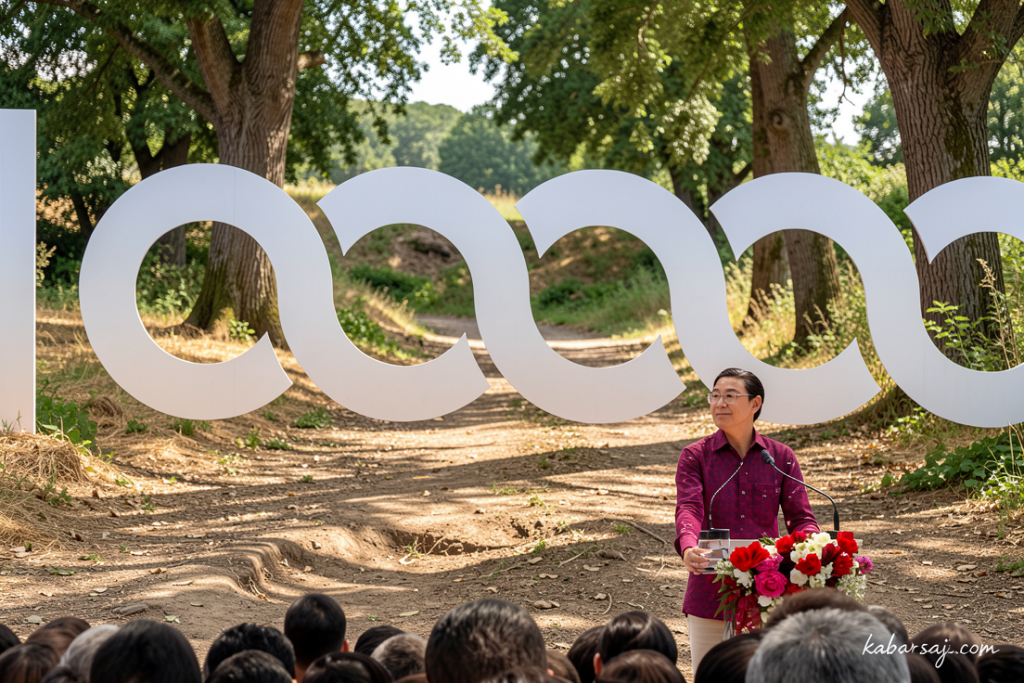
Liu Xueliang, Vice President of BYD Co. Ltd., addressed guests at the ceremony and framed the investment as a long-term partnership rather than a one-off capital injection.
“We have built four major automotive manufacturing divisions here: stamping, welding, painting, and final assembly.”
He went on to stress that BYD intends to engage every layer of the Indonesian economy, from upstream component suppliers to downstream dealerships and end consumers.
“Together, we aim to contribute to Indonesia’s progress toward a greener, technology-driven future.”
The 100,000th Vehicle Milestone
The inauguration doubled as a symbolic checkpoint for BYD’s Indonesian sales operation. The company confirmed that the vehicle delivered to its 100,000th Indonesian customer was an M6 DM, a plug-in hybrid electric vehicle (PHEV) that pairs a conventional petrol engine with an electric drivetrain for extended range without dependence on public charging infrastructure. Reaching six figures in cumulative deliveries within a few years of market entry underscores how quickly BYD has penetrated a country of over 270 million people, many of whom still rely on two-wheelers and small-displacement petrol cars.
Why Subang, Why Now
West Java’s Subang corridor sits roughly 60 kilometres east of Jakarta and benefits from proximity to the Cikarang industrial belt, the Tanjung Priok port, and the toll-road network linking the capital to Bandung. For a manufacturer shipping both finished vehicles and imported components, that geography shortens transit times and lowers freight exposure compared with sites farther south or on outer islands.
The timing also aligns with Jakarta’s regulatory push. Indonesia’s Ministry of Industry has been rolling out local-content requirements, tax incentives for EV assemblers, and a national roadmap targeting a 20-percent electrified vehicle fleet by 2030. A Rp16 trillion plant of this magnitude signals that at least one global OEM views the Indonesian market not as a niche import destination but as a production node capable of serving Southeast Asia and beyond.
Stakeholder Access and Operational Guardrails
Following the formal remarks, BYD walked invited partners, government representatives, and media through the production floor, pausing at each of the four divisions to explain cycle times, automation density, and quality-gate checkpoints. Photography was permitted in most bays but restricted in designated zones along the tour route, a standard practice at automotive plants where proprietary tooling and in-process geometries are treated as trade secrets.
As the Subang complex ramps toward its 150,000-unit annual ceiling over the coming years, its performance will be watched closely by rival OEMs still weighing Indonesian entry, by local unions tracking wage and safety standards, and by consumers waiting to see whether domestic assembly translates into lower sticker prices and shorter delivery windows. The Rp16 trillion question mark has, for now, been answered with a factory gate swinging open.
Related Reading
Frequently Asked Questions
What is BYD Opens Rp16 Trillion EV Factory?
BYD Opens Rp16 Trillion EV Factory is the main topic of this guide. The article explains the context, practical details, and next steps readers should understand.
Why does BYD Opens Rp16 Trillion EV Factory matter?
BYD Opens Rp16 Trillion EV Factory matters because readers are looking for a useful answer, not just a short summary. Good content should match search intent and help them decide what to do next.